The Uplift Blog

Experimentation programs can plateau at every scale, whether they’re running 5 tests a month or 5,000. These plateaus are caused by bottlenecks that can occur anywhere in the process, from generating test ideas to analyzing the results.
Most advice about experimentation velocity covers how to go faster: prioritize better, automate more, run smaller tests. But if your program is still stuck after applying that advice, the cause is usually one of the structural, data, or cultural bottlenecks covered here.
What is experimentation velocity?
Experimentation velocity describes how quickly a program runs experiments: how many tests it completes in a month or quarter, and how long each one takes to get from idea to result.
Each completed test either finds an improvement or rules out a change that didn’t have a meaningful effect, so the more tests a team completes, the more it learns and the more winning changes it ships in a year. Each winning change improves the user experience, and those improvements compound into growth.
Increasing velocity is a central part of scaling an experimentation program. It’s important to note that it’s not enough just to run more experiments; companies should be focused on learning more from the experiments they run.
So, while this article focuses on the experimentation process and potential areas of friction, it is equally important to ensure that new experiments are designed well with clear objectives and the right collection of primary, secondary, and guardrail metrics.
Why experimentation velocity stalls
A program can only complete experiments as fast as its slowest step allows. The bottlenecks below fall into 3 categories: structural bottlenecks that slow down launching a test, data and infrastructure bottlenecks that slow down analyzing the results, and cultural bottlenecks that keep teams from proposing ideas in the first place.
1. Structural bottlenecks
Structural bottlenecks occur in the process of moving an experiment from idea to launch. They’re the easiest type to diagnose because each delayed test is waiting on a specific step, like a sign-off from legal, an engineer to build the variants, or a QA review.
Endless approval chains
In many organizations, an A/B test requires sign-offs from stakeholders in legal, brand, design, finance, and more, just like a big product launch. Those sign-offs make sense for irreversible decisions with a big blast radius, but controlled experiments are reversible by design. They run on a subset of users for a limited time, and tripwires can stop them as soon as a guardrail metric degrades to an unacceptable level. When every reversible change waits in the same approval queue as permanent changes, tests can spend weeks in review, and teams respond by proposing fewer of them.
You can eliminate most of this delay by right-sizing the approval process. For example, high-risk surfaces like pricing and checkout keep the full sign-off process, while low-risk tests, like onboarding or performance improvements, launch with a single reviewer who checks the experiment against predefined criteria.
Engineering dependency
When every experiment requires an engineer to hardcode variants and deploy them, every test waits on engineering capacity. Each test competes with roadmap work in sprint planning, so it waits for a sprint slot, then for code review, then for the next release. On mobile, an app-store review adds another delay for every hardcoded change.
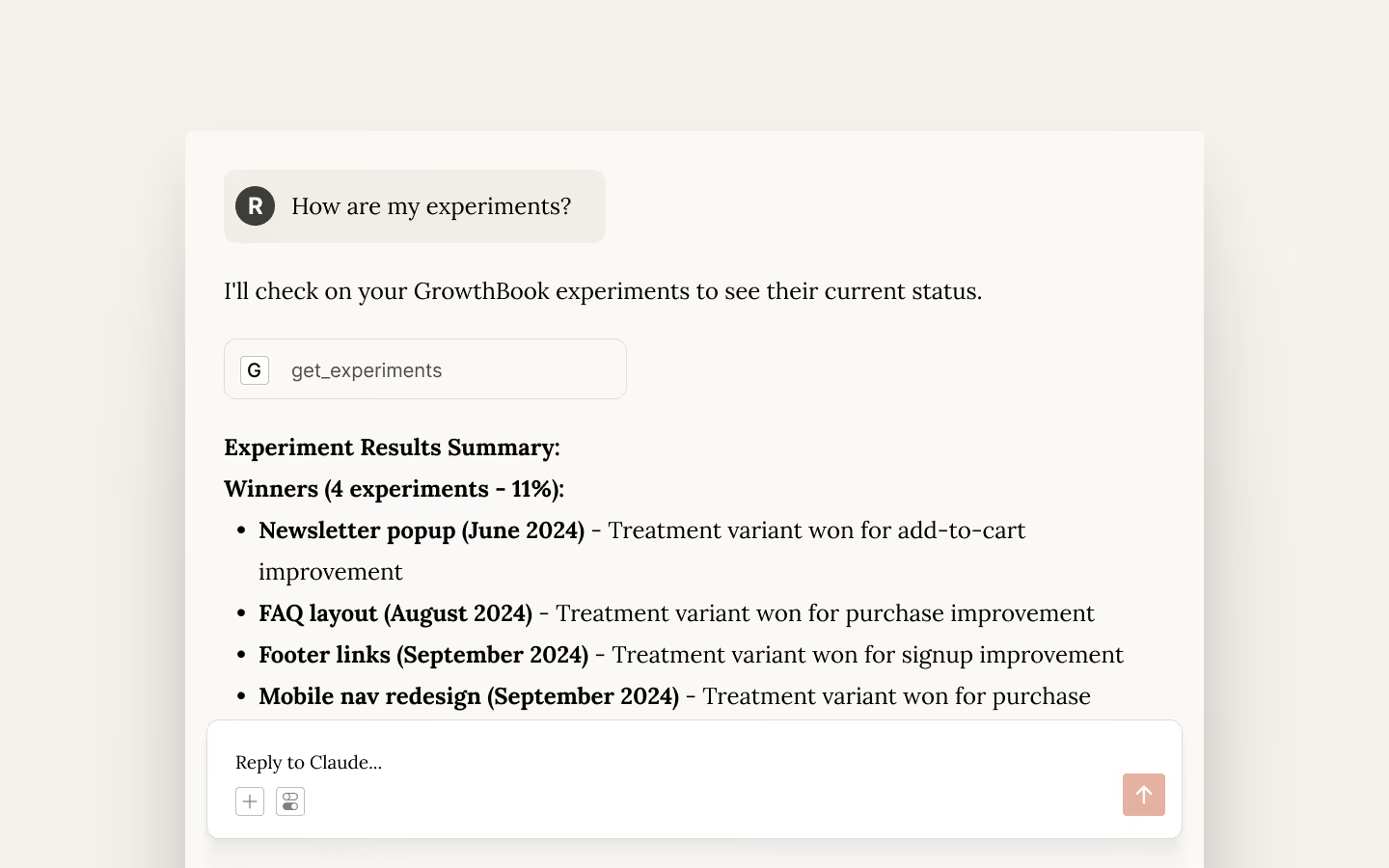
You can remove the engineering dependency with self-serve test creation. Engineers set up feature flags and configuration parameters once, and product managers use them to build new tests or edit pages directly with a no-code visual editor, so a test can launch without a new deployment. AI agents can extend the same self-serve workflow. Connected through an MCP server, an agent can create the feature flags and experiments as drafts that a human reviews before they go live.
Downstream QA and deploy congestion
AI-assisted coding and bigger test backlogs produce more variants to validate, but QA and deployment capacity rarely grows at the same rate, an imbalance known as the velocity paradox. Experiments finish development and then wait for a QA review or the next scheduled release, so cycle time doesn’t improve even though the team is producing more variants.
With feature flags, experiment code ships dark on the normal release schedule and each test turns on independently, so a finished variant no longer waits for its own deployment or the next release. This approach also allows teams to validate new variants in production. A targeting rule exposes the flagged change to the QA team or internal users first, so each variant gets checked in the real environment without a staging deploy, and a kill switch limits the cost of any bug that QA misses. Because each test runs on its own flag, teams can also run multiple experiments at once instead of waiting for one to finish before starting the next.
2. Data and infrastructure bottlenecks
Data bottlenecks usually appear after an experiment launches. Tests start on time, but teams spend weeks validating the results because the numbers live in disconnected tools or because a data scientist has to produce every readout manually. And without a shared experiment repository, teams waste capacity rerunning tests that another team already ran.
Data fragmentation and silos
In many companies, experiment data, product analytics data, and revenue data all live in different tools. Each one uses slightly different tables or metric definitions, like counting conversions per user in one tool and per session in another. An analyst has to explain the discrepancy before anyone trusts the experiment results, and this data reconciliation can sometimes take longer than analyzing the results for insights.
With a single source of truth, no one has to reconcile data across tools. When the experimentation platform reads directly from the data warehouse and every test reuses the same metric definitions, the results in an experiment readout match the figures the business already uses.
Manual statistical calculations
A program that relies on a data scientist for every sample-size calculation, significance test, and data-quality check is limited by data-science capacity. In these programs, a data scientist writes custom queries to pull the results for every test. Health checks that validate the reliability of results, like a test for a sample ratio mismatch (SRM), often run only when someone remembers to request them. Every experiment waits on the same few people.
With an automated stats engine, results update on a schedule, variance reduction with CUPED (Controlled-experiment Using Pre-Experiment Data) shortens the required duration, and health checks run on every experiment. Data scientists can instead spend their time on difficult experimental designs and on interpreting ambiguous results.
No centralized experiment repository
Without an easily accessible shared record of past experiments, teams repeat each other’s work. A revenue team can test a pricing-page change that the growth team tested 6 months earlier, reach a similar result, and never realize they wasted test capacity on duplicate work. The knowledge from thousands of past experiments, like which ideas failed and which patterns should be explored more, stays with the people who ran them.
A central repository of past and active experiments makes that history searchable, so a team can check whether anyone already tested an idea before running it again. GrowthBook’s Learnings feature can even start this library for you, using an agent that scans your past experiments.
3. Cultural bottlenecks
Cultural bottlenecks are organizational norms that discourage experimentation. They’re the hardest type of bottleneck to diagnose because they create invisible delays. An executive’s opinion overrides a test result, teams propose only safe changes, or no one sets aside time to generate new test ideas.
The HiPPO effect
In an experimentation program with a HiPPO problem, the highest-paid person’s opinion (the HiPPO) overrides the data. This habit usually predates the program. Product decisions were owned by senior leaders before there was experiment data, and that ownership often stays in place after the program launches. When a director overrules a test result, or a pet feature ships untested, teams learn that running an experiment doesn’t change the decision. They stop proposing hypotheses on anything an executive already has an opinion about.
Organizations can move past the HiPPO effect by making results visible and hard to dispute. When every stakeholder can see an experiment’s design and the analysis behind its readout, they can flag questionable assumptions early, and a leader who wants to override the result has to do it in the open. Each result that passes that scrutiny builds trust in the data.
Fear of failure
Most experiments fail. The median organization sees roughly 10–20% of experiments move the metrics they were designed to improve, so a healthy program naturally accumulates losing results. In a team with low psychological safety, where a losing test reflects poorly on the person who ran it, people propose small, safe changes that are unlikely to lose but too small to have a meaningful effect. Velocity can even look fine while teams retreat to safe experiments, because trivial tests still count toward the total. The program produces more experiments and less learning.
Teams that treat an invalidated hypothesis as useful information don’t blame the experimenter when a test loses. A losing test identifies a change that would have degraded the metric if it had shipped. Learning that from an experiment costs much less than learning it in production. When teams evaluate experimenters on the quality of their hypotheses rather than on the direction of their results, people feel safe to propose ambitious changes.
No pipeline of test ideas
Even a team with high psychological safety can run out of hypotheses to test. A program that never schedules time to conduct research and ideate will eventually clear its backlog and resort to filling testing capacity with recycled variations of past experiments.
Teams that build a culture of experimentation prioritize hypothesis generation. Regular brainstorms grounded in user research and past results, plus a shared backlog anyone can add to, keep the supply of potential experiments ahead of the program’s capacity to run them.
Removing the experimentation bottlenecks
A program doesn’t need to remove every bottleneck at once. One bottleneck usually constrains velocity more than the others, and improvements elsewhere have little impact until that constraint is removed. If tests launch quickly but analysts spend weeks validating each readout, the constraint is in the data infrastructure, and a faster approval process won’t raise throughput. If analyses come back in a day but the test calendar is thin, the constraint is cultural. Identify the stage where work waits the longest and address that bottleneck first.
The 3 categories of bottlenecks also reinforce each other. Reliable data makes a result harder to override, and a lighter approval process depends on teams proposing enough tests to put through it.
Speed only helps while results stay trustworthy. More experiments produce more false positives in absolute terms, so quality checks, like SRM tests and corrections for multiple comparisons, have to scale with the volume.
How GrowthBook helps remove experimentation bottlenecks
A platform can’t change an organization’s culture, but it can help remove the structural and data bottlenecks. With GrowthBook’s experimentation platform, product managers can create experiments from feature flags and configuration parameters, or edit frontend pages with the Visual Editor, so most tests launch without engineering involvement.
For example, Lingokids used configuration parameters to run 2x as many experiments in parallel, changing paywall layouts and other app behavior through JSON parameters instead of waiting for a new app release. Developers can create feature flags and experiments from their AI coding agents like Claude Code or Cursor, using GrowthBook’s pre-built agent skills and MCP server to automate steps across the experimentation lifecycle.
Because the platform is warehouse native, experiments and product analytics read the same warehouse tables with each metric defined once, and readouts match the numbers the business already trusts. The stats engine computes Bayesian or frequentist results automatically, supports CUPED, and runs an SRM check on every experiment, so teams don’t have to wait for a data scientist to run each analysis.
Every past and active experiment lives in one searchable place, and the Learnings feature turns their results into a shared knowledge library. The governance gates can be applied only where a program needs them.
For example, feature-flag changes can require approval in the environments that need it, while all experiments can carry a pre-launch checklist, and agent-created changes launch as drafts ready for human review. A Slack integration posts experiment launches and results into shared channels, and teams can ask the GrowthBook bot questions about any experiment without leaving Slack. Transparent analyses and shared results make evidence easier to defend.
Watch a 5-minute product walkthrough or join a live demo to see how GrowthBook can remove the bottlenecks slowing down your experimentation program.

The benchmarks are lying to you: why you should A/B test your AI
Feedback loops are the next breakthrough in agentic coding
Holdouts in GrowthBook: the gold standard for measuring cumulative impact

I started talking to my experiments with MCP. Here's what happened


Ready to ship faster?
No credit card required. Start with feature flags, experimentation, and product analytics — free.