Why migrate from LaunchDarkly to GrowthBook
TL;DR: The product and engineering teams we interviewed didn't leave LaunchDarkly to save money on flags that already worked. They switched to get more from one platform. With GrowthBook they were able to:
- Turn any flag into an experiment, with results on your own data warehouse and one set of metrics every team trusts
- Consolidate flagging, experimentation, and product analytics into one connected workflow (Upstart replaced three tools with one)
- Let AI agents create, roll out, monitor, and clean up flags through GrowthBook's MCP and API
- Clear years of flag debt and keep it clear with stale flag detection and AI-assisted cleanup
- Migrate faster than they expected: the LaunchDarkly Importer moves your flags, and GrowthBook helps with scripts and complex rules
For many teams, the conversation about moving off LaunchDarkly starts with cost, a closer look at the value they're getting, and pressure from leadership to consolidate vendors. But when your flags work today, a lower bill alone may not justify the time and effort of switching platforms.
The strongest case for migration is what GrowthBook makes possible: feature flagging, experimentation, and product analytics together in one platform.
When many teams chose their flagging tool, AI played little to no role in software development and experimentation, and product analytics often lived in separate platforms. Today, AI is accelerating development, expanding what's possible to test, and creating new demands for how teams build and ship products. This turns migration into an opportunity to rethink not only your flagging tool, but the workflows around it.
We interviewed product and engineering leaders at companies that migrated to GrowthBook from LaunchDarkly. This post summarizes why they migrated and the practical lessons they learned along the way, including how AI has changed what teams need from feature flagging.
"GrowthBook gives us the flexibility to self-host and connect our own data sources. Our migration to GrowthBook was straightforward, and its support for both feature flag management and experimentation means fewer tools to maintain and learn."
— Paige Ruppel, Principal Software Engineer, Upstart
Why teams migrate from LaunchDarkly to GrowthBook
GrowthBook’s experimentation capabilities makes the switch worth it
The teams we spoke with told us LaunchDarkly was meeting their flagging needs, even if they didn’t feel they were getting enough value for the price they were paying. Cost savings alone, however, weren’t enough to justify replacing it with a like-for-like solution, as they were comfortable with the platform and switching tools would take valuable engineering time.
In every instance, GrowthBook’s experimentation capabilities tipped the decision and made a clear business case to migrate.
Running both flags and experimentation from GrowthBook let teams retire homegrown A/B setups, drop separate testing tools, or gave those not yet testing a clear path to start. It also came with the added bonus of bringing product analytics into the same platform, leading some teams to consolidate a third-party tool in some cases.
"Experimentation drove our decision to migrate. We probably wouldn't have moved off LaunchDarkly if GrowthBook hadn't offered experimentation on top of feature flagging."
— GrowthBook user
Consolidation gets you more value and functionality, not just a smaller bill
Feature flagging, experimentation, and product analytics are three steps in the product development loop: ship a change, test whether it works, and see how it moves the metrics that matter. When each step lives in a different tool, the loop breaks. Teams hand off between systems, reconcile metrics that don’t match, and lose the link between what shipped and what changed.
Many teams we interviewed first came to GrowthBook to consolidate vendors and lower their bill. But the biggest value they got was having the whole loop in one place. Any flag can become an experiment, every rollout is measured against the same metrics, and the results inform what to build next. That’s value far beyond just a smaller bill.
Here is some of the specific feedback we heard:
- Three tools consolidated into one connected workflow. Upstart was running a third-party flagging tool alongside two in-house experimentation systems. After consolidating all three into GrowthBook, engineers launch experiments in hours instead of days, see results in real time, and quickly catch underperforming experiments. Preloaded, standardized metrics resolved inconsistencies caused by human error, and one tool instead of three cut maintenance and cognitive load. Read the Upstart case study.
"We had to rally our teams for this project and get our old tools cleaned up, but the process is significantly improving the quality of our systems and reinforcing best practices around experiments and feature-flagging hygiene."
— Diego Accame, Director of Engineering, Growth, Upstart
- Flag users organically become experimenters. Any flag can become an experiment, so testing is one step away from shipping. At one company, engineers who were using GrowthBook only for flags naturally started exploring experiments because both lived in the same place.
"Having flags and experiments in one platform has organically pulled engineers into experimentation who initially came in for flags."
— GrowthBook user
- A clear path to adopting experimentation. One team we spoke with wasn’t yet running experiments, but plans to as its program matures, which is the reason they selected GrowthBook. They already flag every code change so it can be reverted without a rollback. When it's ready, those same flags will become its first A/B tests.
- Measure against one set of metrics. Another team told us that before migrating, each team had their own metrics and conventions. Their numbers disagreed, and nobody could say which was right. As part of the move, they built a common metrics layer across the organization, so every team now works from the same metrics and tracking, which they fully control. As flags roll out, teams track how those metrics move and use the results to decide what to build next.
"We chose GrowthBook to unify feature flagging and experimentation for better management, along with the depth of control it offers over metrics and data pipelines."
— GrowthBook user
The result is one connected loop for shipping, testing, measuring, and learning what happens after they ship. By tracking how key metrics move as flags roll out, they can see whether changes are having the intended impact and use those insights to inform what comes next.
For a side-by-side comparison, see GrowthBook vs LaunchDarkly.
Lessons learned from teams that made the switch
AI has created new demands for feature flagging
The teams we interviewed selected LaunchDarkly before AI agents became a standard part of software development. As AI transforms workflows, it’s a good reason to reassess whether their existing platform can keep up. AI-driven development creates new demands for how teams release changes, manage risk, and measure impact.
For teams evaluating GrowthBook, support for AI agents was an important consideration. They were either already replacing manual work with agent-driven workflows or wanted the flexibility to adopt them in the future. Either way, they needed a platform that let agents manage the full release lifecycle, from creating and rolling out flags to monitoring impact and cleanup, through APIs and MCP integrations directly from their coding environments.
"Long term, we expect more of our day-to-day work to move through AI agents and the MCP server rather than manual UI actions. We eventually want agents to autonomously build and launch experiments end-to-end."
— GrowthBook user
Faster development makes reliable release controls even more important. Teams need to roll out changes gradually, monitor their impact in production, catch issues quickly, and roll back when something goes wrong. Feature flags provide a way to move quickly without exposing every user to a change at once.
These safeguards are also increasingly relevant as teams introduce AI-powered features, where changes to prompts and models may need to be rolled out incrementally and evaluated in production. They let teams ship fast while using feature flags as a safety net.
Migration is an opportunity to improve how you ship
The teams we spoke with often set up the basics of feature flagging with LaunchDarkly, established their release workflows, and moved on to other priorities. Over time, flags accumulated, cleanup fell behind, and teams rarely revisited how they managed feature flags or the value they were getting from the platform.
Migration created an opportunity to address that accumulated debt, adopt more advanced release practices, and rethink how teams manage flags over time.
Clean up flag debt to start fresh
Stale flag debt was consistently the biggest hurdle during migration. Teams had to sort through years of accumulated flags, identify which were still in use, retire those that had served their purpose, and decide which to bring over. This process takes time, but it also creates an opportunity for a fresh start rather than carrying unnecessary technical debt into a new platform.
Going forward, GrowthBook's stale flag detection and AI-assisted cleanup maintains code hygiene by helping teams identify and remove flags that have outlived their purpose.
"Flag hygiene, via the REST API and Claude/Codex tooling through the GrowthBook MCP, is now a regular workflow, not a one-time task."
— GrowthBook user
Move beyond basic feature flagging
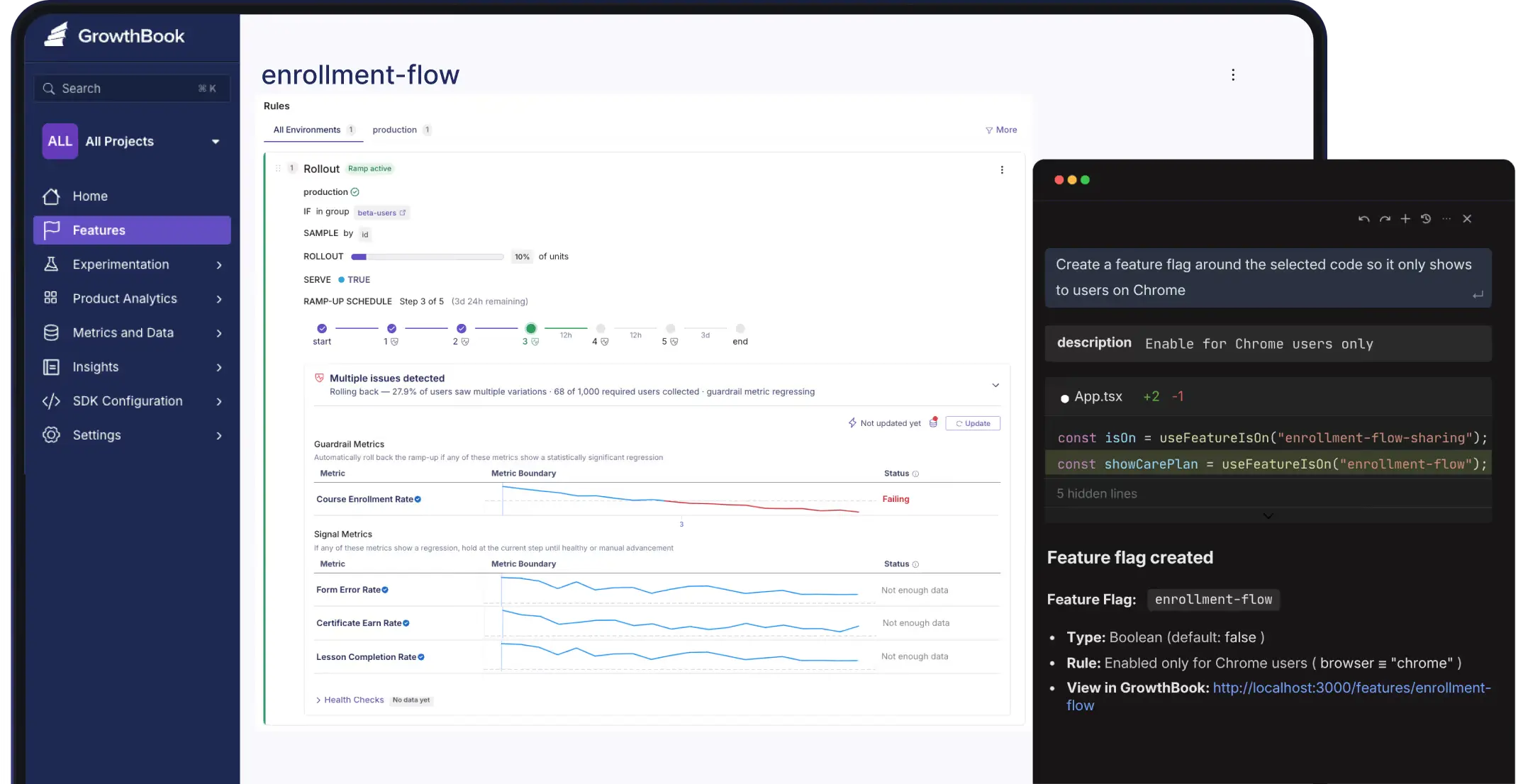
Many teams we spoke with were barely scratching the surface of what feature flags can do. Gradual rollouts, ramp schedules, audience targeting, and automatic rollbacks give teams more control over how changes reach users and help manage risk as they release. Migration is an opportunity to rethink workflows, adopt these capabilities, and establish consistent release practices across the organization.
Bring AI into your flagging workflow
Migration is also a chance to identify where AI can make feature flagging more efficient. Many teams are still figuring out where to start, but they don't have to do it alone. GrowthBook partners closely with teams to help them adopt AI-driven workflows and has laid much of the groundwork with a repository of AI skills.
With GrowthBook’s MCP and API, agents can manage feature flags directly from your coding environment, execute release tasks, and automate parts of flag maintenance, all while maintaining appropriate guardrails and human oversight. Templated ramp rollouts can also help standardize how changes are released, giving agents a consistent process to follow.
Migration is faster and easier than teams expect
Migrating feature flagging platforms can sound like a major engineering project. But with a clear plan and support from GrowthBook, your team can control the timeline and make the transition on your terms.
The real time investment is cleaning up flag debt, not moving the flags themselves.
For the move itself, GrowthBook’s LaunchDarkly Importer does most of the work. It connects to your LaunchDarkly account and brings over your projects, environments, and feature flags, including targeting rules, rollouts, and prerequisites. You review a preview before anything imports and can skip flags you don’t want to bring over.

GrowthBook can also help make the transfer of flags as seamless as possible, including writing migration scripts and guiding teams through the process to handle any complex rules or mapping. You're not left to figure it all out on your own.
For teams migrating both feature flagging and experimentation into GrowthBook, these efforts can run in parallel, minimizing disruption to ongoing work.
"Overall, it went really well with minimal friction, despite migrating both feature flagging and experimentation simultaneously. GrowthBook wrote a custom script that handled much of the logic translation between platforms so we could import projects directly, which removed a large share of the manual mapping work."
— GrowthBook user
Ready to migrate from LaunchDarkly to GrowthBook?
You can evaluate GrowthBook without a contract or commitment. Migration is an opportunity to bring feature flagging, experimentation, and product analytics into one connected workflow.
See how GrowthBook compares to LaunchDarkly or talk to our team for help planning your migration, or get started for free.

Related articles
Ready to ship faster?
No credit card required. Start with feature flags, experimentation, and product analytics — free.