7 Best LaunchDarkly alternatives & competitors (2026)

LaunchDarkly is the enterprise default for feature management, and for good reason. It offers mature governance, broad SDK coverage across 25+ languages, progressive delivery controls, and since the Highlight acquisition in 2025, an observability layer for release monitoring.
The platform was built for release governance, and it excels there. But here are a few areas that make many users report an issue with:
- Usage-based pricing that increases as you grow. So, you pay per service connection and per client-side monthly active user, and teams regularly report costs doubling at renewal with little visibility into what drove the increase.
- The experimentation product is sold as a separate paid add-on with its own metering at $3 per 1,000 client-side MAUs, in addition to your existing feature management tier.
- There’s no self-hosting option for the control plane. This is a problem for engineering organizations with strict data-residency requirements or air-gapped environments.
- There are documented reliability concerns, including the October 2025 outage that affected flag evaluation for multiple customers.
- It’s closed source with no way to audit the stats engine or fork the code if the vendor relationship changes.
A recent Reddit thread drew dozens of engineers making this exact point. The tool that simplified releases has become its own source of vendor lock-in.

If you’re looking for a LaunchDarkly alternative, this guide walks you through 7 platforms that include a combination of feature management, experimentation, analytics, and deployment governance.
What is LaunchDarkly?
LaunchDarkly is a proprietary enterprise feature management platform that’s now specifically catering to companies adopting AI-native development processes. It was established in 2014 and was one of the first tools to give engineering teams a way to separate deployments from releases at scale. Since then, though, it has expanded well beyond that original scope through acquisitions.
The platform covers the core feature management workflow and, as of 2026, also spans observability and analytics. You get:
- Boolean and multivariate feature flags with percentage-based rollouts
- User targeting and segmentation by attributes and custom contexts
- Approval workflows, audit logs, role-based access controls, and environment-level permissions
- Progressive delivery with kill switches and flag scheduling
- Experimentation via a paid add-on with its own stats engine
- Warehouse-native analytics via the Houseware acquisition (February 2025), currently Snowflake-only
- Session replay and error monitoring via the Highlight acquisition (April 2025)
The Highlight acquisition was one of the reasons the company repositioned LaunchDarkly around what the company calls “Runtime control for AI-era software.” In practice, the platform now spans feature flags, experimentation, analytics, and observability. But all of those products are billed separately, which balloons the overall cost of ownership. It has four pricing plans:
- The free Developer tier caps you at 5 service connections and 1,000 monthly active users.
- Paid plans start with Foundation, priced per service connection plus per client-side MAU, with experimentation billed separately at $3 per 1,000 client-side MAUs.
- Enterprise and Guardian tiers use custom pricing for advanced security and governance features.
When it comes to deployment, it’s SaaS-only with no self-hosted control plane. The Relay Proxy lets you cache flag evaluations locally, but the management UI, targeting rules, and experiment configuration all depend on LaunchDarkly’s infrastructure.
As of July 2026, G2 users rate it 4.5/5 based on 740+ reviews.
It’s built for large engineering organizations with complex release pipelines and strict compliance requirements. But if you need experimentation, analytics, governance, and feature flags working together without separate billing for each, you’ll want a platform that integrates these capabilities from the beginning.
Why engineering and product teams look for LaunchDarkly alternatives
Even though LaunchDarkly does feature management well, engineering and product teams start evaluating alternatives when issues start arising after the flag goes live. Here’s what happens:
- The usage-based pricing model is unpredictable: LaunchDarkly bills per service connection on the server side and per monthly active user on the client side. Many LaunchDarkly users say that the costs frequently spike at renewal. In fact, one user said their annual contract would increase from $10,000 to $45,000 under the new pricing model. These billing surprises come too late, when you’re already locked in, and migrating can be a huge hassle. Many teams find LaunchDarkly to be too expensive and end up looking for a cheaper alternative.
- Experimentation sold as a paid add-on: The experimentation module isn’t bundled with feature flags. It’s a separate product with separate billing. And it’s metered layer at $3 per 1,000 MAUs. The stats engine offers Bayesian and frequentist methods, but percentile analysis is still in beta and incompatible with CUPED. Also, funnel metrics are limited to average analysis only. If you want to run experiments with the rigor you’d apply to product analytics, you’re paying extra for a module that doesn’t fully deliver it.
- The stats engine is a black box: You can see experiment results within the platform, but you can’t reproduce the statistical calculations independently or validate them in your own warehouse. They don’t publish their methodology, so there’s no way to audit how results are computed. For data teams that need to verify outcomes before making product decisions, this is a significant gap.
- No self-hosting option: The control plane is SaaS-only. That means your targeting rules, experiment configuration, user segments, and the management dashboard all run on LaunchDarkly’s infrastructure. If you’re in a regulated industry or need an air-gapped environment, this won’t work because it poses a significant security and compliance risk.
- Reliability tied to vendor uptime: LaunchDarkly has logged over 800 tracked outages since November 2019. The October 2025 incident affected approximately 99% of server-side SDKs globally for 24 hours. Even though the Relay Proxy mitigates network dependency, it adds operational complexity, and you’re still dependent on the vendor for configuration updates. The new updates have also resulted in a more unstable version of the app, forcing users to look for more reliable alternatives.
- Warehouse-native capabilities limited to Snowflake: The Houseware acquisition added warehouse-native experimentation, but it’s currently restricted to Snowflake and requires high-level account permissions to set up. The platform-managed metrics can fall out of sync with your warehouse data, creating discrepancies between what LaunchDarkly reports and what your data team sees.
- Complex targeting that requires cross-team coordination: LaunchDarkly’s multi-context targeting model requires upfront schema design and SDK-level changes. If you’re adding a new targeting rule, you’ll need to coordinate across engineering teams, and you can run only one active experiment per feature flag without workarounds. This issue limits how quickly you can iterate.
- No native way to measure rollout impact: The platform controls how features ship, but doesn’t connect the rollout to an actual result. You’ll need additional tools to actually see if the feature flag and its associated rollout made a difference to business-related metrics.
- Closed source with high switching costs: LaunchDarkly SDKs, which are roughly twice the size of most competitors’, embed deep into your codebase across services. It takes months to migrate from LaunchDarkly, and there’s no way to run a self-hosted fallback during the transition. The code is proprietary, so you can’t fork it or audit the internals.
What to look for in a LaunchDarkly alternative
Here are a few things you need to look at before choosing an alternative to LaunchDarkly:
- Breadth versus depth: Do you need a single-purpose feature management platform, or an all-in-one tool that bundles experimentation, analytics, and session replay? A dedicated platform will go deeper into flag governance and release safety, but an all-in-one platform will consolidate your tool stack. However, the latter could treat any single capability as one product among many, so the product you need may not be as robust.
- Pricing model predictability: LaunchDarkly bills per service connection and per client-side MAU, with experimentation adding another metered layer. While per-seat pricing scales with your team size, per-MAU and per-event pricing scale with your traffic. You really need to look at your traffic patterns and team size to see which model makes the most sense for your organization.
- Built-in experimentation with a transparent stats engine: Some platforms include experimentation as a core capability with an open, auditable statistical methodology. If your data team needs to reproduce and verify results, the difference matters because it decides how credible your experiments are—especially if you’re making product-related decisions.
- Self-hosting and open source: A full self-hosted deployment gives you control over data residency, air-gapped environments, and vendor independence. But an open-source license (MIT or Apache 2.0) adds another layer of transparency and auditability. In this case, you can audit the code, fork it if the vendor relationship changes, and contribute to the product. This gives you more space to comply with regulatory requirements while building confidence in your infrastructure.
- Warehouse-native measurement: If your data already lives in Snowflake, BigQuery, or Redshift, a warehouse-native platform can run experiment analysis directly against your existing tables. This keeps metrics consistent across your analytics pipeline and eliminates the need to reconcile numbers between vendor dashboards and your own data warehouse. If you do use other platforms, check if the alternative actually integrates with them.
- Depth of governance and at what tier: These days, governance features like approval workflows, audit logs, RBAC, ramp schedules with guardrails, and stale flag detection are table stakes even for mid-market teams. But most feature flagging, experimentation, and analytics platforms gate it behind enterprise tiers. So cross-check that before signing up.
- SDK coverage and evaluation architecture: Choose a platform with SDKs for every language in your stack. Evaluate the initialization workflow because some SDKs require a network call on every evaluation, which adds latency to every request. Others evaluate locally from a cached payload and stay off your hot path entirely.
- Migration path from LaunchDarkly: Switching feature flag platforms touches every service that evaluates a flag. Look for a dedicated importer that can pull your existing flags, environments, targeting rules, and rollout configurations via API. This is the part that decides whether you’ll actually spend months migrating between platforms.
Best LaunchDarkly alternatives in 2026
Here’s how different alternatives to LaunchDarkly stack up against each other:
1. GrowthBook
GrowthBook is an open-source platform that pairs enterprise-grade feature flags with built-in, warehouse-native experimentation and product analytics. It also offers full self-hosting so you can stay compliant with different regulations in your industry.

You can think of GrowthBook as three products inside one MIT-licensed codebase:
- A fast feature flag engine with 24+ SDKs and sub-millisecond local evaluation
- A production-grade experimentation engine that runs SQL against the warehouse you already use.
- A strong product analytics product that acts as a managed warehouse for your product data.
All your feature flags evaluate from a locally cached payload, so your application never depends on GrowthBook being available. That’s how companies like Dropbox process over 3 billion flag evaluations daily on self-hosted GrowthBook. The platform is trusted by Khan Academy, Upstart, Breeze Airways, Mistral, and 3 of the 5 largest LLM companies in the world.
“GrowthBook gave us a modern experimentation and release platform that actually fits how Dropbox works. We can run analytics directly on our data lake, roll features out safely in stages, and support teams across different stacks without duplicating data or tooling.”
— Alex Kalish, Engineering Manager, Dropbox
In fact, GrowthBook’s latest 4.4 release closed the governance gap that enterprise teams previously cited when comparing to LaunchDarkly. You get in-depth features like:
- Ramp schedules to define staged rollouts with guardrail metrics at each stage and auto-rollback if those metrics degrade.
- Approval workflows now cover environment kill switches, prerequisites, saved groups, and metadata changes.
- The rebuilt API exposes over 250 Zod-driven endpoints
- The MCP server makes the full experiment and flag lifecycle programmable for tools like Claude Code and Cursor.
In short: GrowthBook doesn’t treat feature flagging, experimentation, or product analytics as three separate modules—but rather as one platform to make better product decisions.
GrowthBook key features
Pros of GrowthBook
- Create and manage feature flags, experiments, and rollout plans directly from Claude Code or Cursor through the MCP server and the rebuilt REST API.
- Smart feature flags with ramp schedules, per-stage guardrail metrics, and auto-rollback connect to any metric in your data warehouse. You can ship features at velocity and verify they’re working without switching tools or waiting for a separate analysis.
- Flags and experimentation live on a single platform with a single data source, so you don’t reconcile data across vendors. Several users say that these capabilities being available on a single platform make it a much more affordable option.
- The lightest-weight SDKs in the category evaluate locally with zero network calls, so your application never depends on GrowthBook’s availability.
- Per-seat pricing with unlimited traffic and experiments means your bill stays predictable as your product scales. GrowthBook costs roughly 1/5th the cost of LaunchDarkly for comparable deployments.
- The stats engine is fully open source, and every calculation is reproducible via SQL. Your data team can audit the math on GitHub rather than trusting a vendor’s black box.
- Even though it has its own experimentation product, you can still import data from other tools and analyze it in GrowthBook.
Drawbacks of GrowthBook
- Full experimentation value depends on having a data warehouse. GrowthBook Cloud now offers a Managed Warehouse, but self-hosters need to bring their own.
- Fewer federal-specific compliance certifications compared to LaunchDarkly. Even though it has certifications such as SOC 2 Type II and ISO 27001, it’s not FedRAMP or ISO 27701-certified.
- No Terraform provider for infrastructure-as-code workflows.
- Narrower niche SDK coverage. LaunchDarkly supports Haskell, Erlang, and Apex, in addition to the standard set. GrowthBook’s 24+ SDKs cover most platforms but don’t support these legacy runtimes.
How GrowthBook compares to LaunchDarkly
Both platforms handle enterprise feature management, but they’re built on different assumptions about what happens after the flag goes live:
- GrowthBook wins for teams that want enterprise-grade feature flags with predictable per-seat pricing, open source and full self-hosting, lighter SDKs with zero-network-call evaluation, and built-in experimentation measured in their own warehouse—at roughly 1/5th the cost. The dedicated LaunchDarkly importer means most teams complete the migration the same day.
- LaunchDarkly wins for large enterprises that need the most mature release-governance ecosystem with multi-stage approvals, the broadest integration catalog (including native Terraform and ServiceNow), specific federal compliance certifications like FedRAMP, and are comfortable with cloud-only, usage-based pricing.
See a full side by side comparison of GrowthBook vs LaunchDarkly.
Who is GrowthBook best for?
Engineering, product management, and data teams from any kind of company, whether it’s a startup or an enterprise. These companies typically want LaunchDarkly-grade feature flag management plus real experimentation without per-MAU pricing or vendor lock-in. It’s a particularly strong fit for companies in regulated industries like fintech, healthtech, and AI software, where data sovereignty and self-hosting are non-negotiable.
2. PostHog
PostHog is an all-in-one, MIT-licensed product platform that bundles product analytics, feature flags, A/B testing, session replay, error tracking, surveys, and heatmaps into a single codebase.

The platform’s main focus is on consolidation, so instead of stitching together LaunchDarkly for flags, Amplitude for analytics, and FullStory for session replays, you get all of it from one vendor with a shared event model. Considering this, the pricing model is quite generous and usage-based, and in fact, 90% of PostHog users don’t pay for the platform.
But where it actually differs from LaunchDarkly is the scope of the product. While LaunchDarkly was built for feature management, PostHog was built analytics-first—and it shows. So, you might get robust analytics data, but you won’t get the feature-flagging depth that the former offers.
PostHog key features
Pros of PostHog
- Analytics, flags, experiments, session replay, error tracking, surveys, heatmaps, and a CDP in one tool with a shared event model. You don’t reconcile data across vendors because everything runs on the same data layer.
- The free tier includes 1M analytics events, 5K session recordings, and 1M feature flag requests per month with no credit card required. Most small teams never hit the paid threshold.
- The core codebase is MIT-licensed and self-hostable for full data control, though the infrastructure footprint is substantially larger than that of lighter-weight alternatives.
- You can go from a funnel drop-off to the exact session recording that shows what happened, without switching tools. In fact, even error tracking becomes easier because of the qualitative data at hand.
- Many users also say it’s quite easy to install and get started with, even if you’re a non-technical user.
Drawbacks of PostHog
- The experimentation engine is not as advanced as GrowthBook or LaunchDarkly. For example, it doesn’t offer sequential testing, CUPED variance reduction, post-stratification, or SRM detection. You can’t add metrics retroactively after an experiment starts.
- PostHog analyzes experiment results inside its own platform, not in your data warehouse. Results aren’t reproducible via SQL against your own data, and you can’t audit the calculations.
- Growth and marketing teams can’t run headline tests or CTA changes without a visual editor — every experiment requires code.
- Every experiment evaluation counts as a feature flag request, which means high-traffic experiments directly increase your bill. You’ll need to plan your event-tracking strategy carefully to avoid it.
- Self-hosting requires ClickHouse, Kafka, PostgreSQL, and Redis at a minimum, along with 4 vCPU, 16GB RAM, and 30 GB+ of storage. Kubernetes deployments are no longer officially supported for new installs. The company actively discourages self-hosting for that reason.
- The web app tends to use too much memory, which can slow down your browser/computer while you use it.
How PostHog compares to LaunchDarkly
PostHog and LaunchDarkly solve different problems. Here’s how they compare with each other:
- PostHog wins for product teams at startups and mid-stage companies that want one vendor for analytics, flags, session replay, and experimentation. And this is especially true if the free tier covers their volume and they value MIT-licensed source code.
- LaunchDarkly wins for mid-sized and enterprise teams that need multi-stage approval workflows, the broadest integration catalog, federal compliance certifications, and deep feature management. LaunchDarkly also has stronger enterprise governance controls that PostHog simply doesn’t offer right now.
Who is PostHog best for?
Product teams at startups and growth-stage companies want to consolidate their analytics, feature flag, session replay, and experimentation tools into a single platform. If you’re currently paying for Amplitude plus LaunchDarkly plus FullStory and want one vendor instead, PostHog is designed for that tradeoff. It’s less suited for teams that need deep, warehouse-native experimentation or enterprise-grade release governance.
3. Statsig
Statsig is a product experimentation platform founded by former Facebook VP of Engineering Vijaye Raji. The platform bundles feature flags, A/B testing with advanced statistics, product analytics, and session replay.

While it’s known for its excellent experimentation capabilities, its recent acquisitions have brought that into question. In September 2025, it was acquired by OpenAI, but by May 2026, Amplitude took over the Statsig brand. Essentially, Amplitude takes over the code but not the team behind it. It has not yet been clarified how Statsig’s warehouse-native architecture will coexist with Amplitude’s event-stream roots, or what the pricing will be at renewal.
Statsig key features
Pros of Statsig
- It offers various analysis methods, such as CUPED, sequential testing, stratified sampling, switchback experiments, mutual exclusion layers, and holdout groups. Before the acquisition, this was one of the most statistically rigorous experimentation platforms.
- Enterprise customers can run experiment analysis directly in their own BigQuery, Snowflake, Databricks, or Redshift instance through warehouse-native mode. Data never leaves your infrastructure.
- The free Developer tier includes 2M metered events per month, unlimited seats, and 50K session replays with no credit card required. Analytics and experimentation are both included.
- You can define customer user dimensions, which makes it easier to slice and dice data as you see fit.
Drawbacks of Statsig
- The engineering team that built Statsig is at OpenAI. Amplitude inherited the code, customers, and brand — but not the people. How quickly Amplitude can staff up, learn the codebase, and ship improvements is an open question that every buyer should pressure-test before signing a multi-year contract.
- The platform is entirely proprietary and cloud-only. You cannot audit the statistical engine or run the platform on your own infrastructure.
- Some users report that the platform can feel overwhelming at first, and it takes time to set up (typically days to weeks).
- Feature flagging capabilities are best suited to experimentation use cases rather than launching new features. Statsig’s bread and butter is A/B testing.
- Statsig’s feature flags auto-capture a lot of metrics, which is useful for product analytics, but can cause Statsig’s event-based pricing to increase dramatically, even if the customer isn’t using Statsig product analytics.
- Event-based metering means costs grow with traffic. So, higher-volume applications can see bills increase faster than expected, and you’ll need to jump between plans to keep up.
How Statsig compares to LaunchDarkly
Statsig and LaunchDarkly overlap on feature flags but differ in the depth of experimentation. Here’s how you can choose:
- Statsig wins (or won, pre-acquisition) for teams that want advanced experimentation bundled with feature flags and analytics at a lower entry price than LaunchDarkly’s experimentation add-on.
- LaunchDarkly wins for enterprise teams that prioritize platform stability, the broadest compliance certifications, and mature release governance.
Who is Statsig best for?
Teams that already use Statsig and are evaluating whether to continue using it through the Amplitude transition. For new buyers, the calculus is different: the experimentation engine is strong, but signing a new contract with a platform mid-ownership change requires confidence that Amplitude will maintain the quality and roadmap that attracted customers in the first place. If you need warehouse-native experimentation from an independent vendor, GrowthBook is a much more stable long-term bet.
4. Optimizely
Optimizely is an enterprise digital experience platform (DXP) that bundles several features under the Optimizely One brand. Some of them include:
- A/B testing
- Feature flags
- Content Management System
- Commerce
- Content marketing
- AI-powered personalization

It was founded in 2009 as a pure-play A/B testing tool. The company was acquired by Swedish CMS vendor Episerver in 2020, which rebranded itself as Optimizely in January 2021. That’s how it moves on from being a pure experimentation platform to “powering” digital experiences. The pricing is quite comparable to LaunchDarkly, as they cater to enterprises. In fact, the average contract value is $82,894, according to public data.
But if you’re evaluating Optimizely specifically as a LaunchDarkly alternative for feature flags, you’re buying a full DXP to solve a feature management problem.
Optimizely key features
Pros of Optimizely
- Several users say it’s not that hard to set up feature flagging for experimentation, even though implementing the full suite takes months.
- The Web Experimentation product gives marketing teams a no-code visual editor for client-side A/B tests, so you don’t have to write code.
- You don’t need extensive technical knowledge to set up and run experiments within the platform.
- Warehouse-native analytics connect experiment results to Snowflake, BigQuery, Databricks, and Redshift, enabling you to tie experiments to downstream metrics such as LTV and subscription renewals.
- For enterprises already using Optimizely’s CMS or Commerce Cloud, adding experimentation means having a single vendor for content, commerce, and testing, with shared audience definitions.
Drawbacks of Optimizely
- While you can use the feature experimentation platform to define experiments and run them, integrating in-house metrics can be particularly problematic.
- There’s no free tier or even a trial version you can demo before using the product. There’s no way to evaluate the costs without talking to sales—and users report it’s too expensive for what it is.
- There’s no open-source option and no self-hosting. The platform is entirely proprietary and cloud-hosted, so if you have data-residency requirements, you can’t use it.
- When you add more audiences or handle a large audience in the experimentation platform, the front end suffers. The app slows down because it has to load too many elements and doesn’t render quickly. And it’s also difficult to track the specifics later.
- Its flag management tooling is weaker than dedicated feature management platforms. You don’t have capabilities like an overview of running versus stale flags, custom tagging or labeling, insights into flags running too long, or native Slack integration for flag notifications.
- SDK coverage is narrower at 12 SDKs compared to LaunchDarkly’s 25+ or GrowthBook’s 24+. There’s no Haskell, Erlang, Rust, Elixir, or edge runtime support.
- No automated rollback tied to health metrics. While LaunchDarkly offers Guarded Rollouts with circuit-breaker-style automatic rollback, GrowthBook offers ramp schedules with automatic rollback—but Optimizely offers neither.
How Optimizely compares to LaunchDarkly
Both these platforms were made for enterprise companies, but they serve different buyers. Let’s see how they compare:
- Optimizely wins for enterprises that need a no-code visual editor for marketing-led experiments, want CMS and commerce capabilities alongside experimentation, and have a mid five-figure USD budget for multi-year contracts. The experimentation stats engine is also more methodologically complete than LaunchDarkly’s add-on.
- LaunchDarkly wins on feature management depth, SDK breadth, automated rollback with Guarded Rollouts, enterprise governance maturity, and federal compliance certifications. It’s also substantially less expensive for teams that only need feature flags.
Who is Optimizely best for?
Large enterprises with huge annual budgets that need marketing-led web experimentation alongside server-side feature flags—especially if they already use Optimizely’s CMS or Commerce Cloud. If you’re evaluating it purely as a LaunchDarkly alternative for feature management, it’s dramatically over-scoped and overpriced for that single use case.
5. Split (Harness)
Split (by Harness) is a feature management and experimentation platform that Harness acquired in June 2024 and now sells as Harness Feature Management and Experimentation (FME). Its original pitch focused on being a “Feature Data Platform” in which every toggle corresponds to business and engineering metrics. But over time, the platform has changed completely.
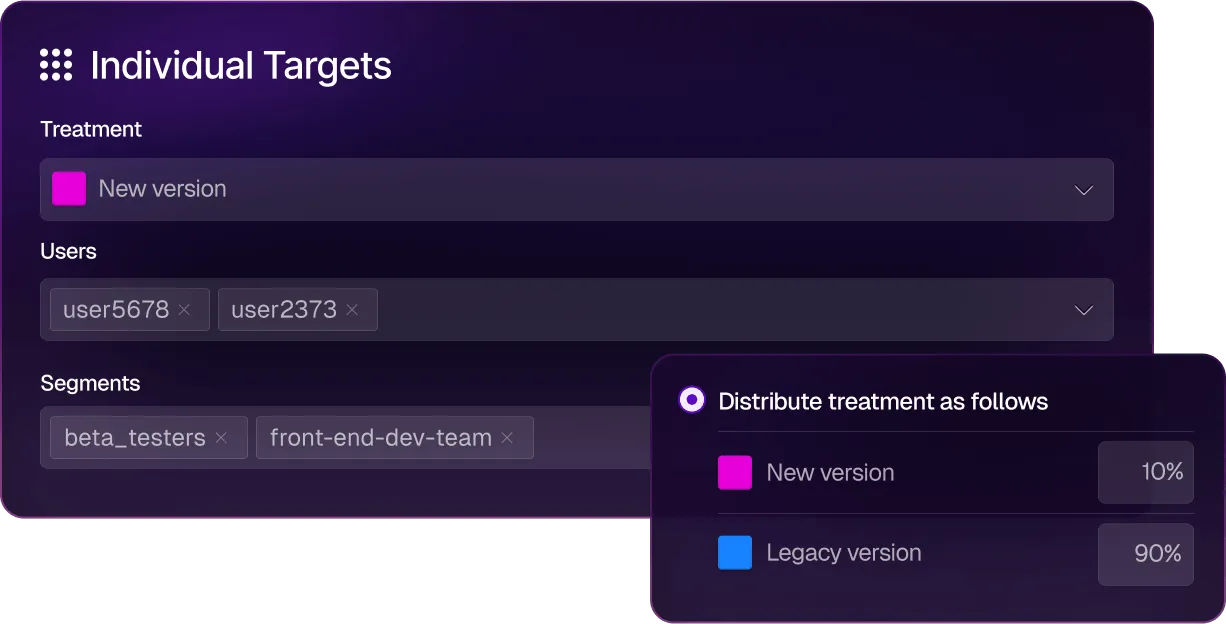
Despite being a strong feature flagging and experimentation platform, Split is no longer a standalone platform. It sits inside Harness’s broader DevOps platform alongside CI/CD, security testing, cloud cost management, and chaos engineering. FME is only available on the Enterprise tier, and you need to contact sales to find out the actual cost. For teams that only need feature flags and experimentation, engaging with the full Harness platform feels like overkill.
Split (Harness) key features
Pros of Split (Harness)
- Automated impact measurement ties every flag toggle to business and engineering metrics without requiring manual experiment setup. You can toggle a flag and immediately see whether it moved conversion rates or error rates with statistical significance calculated automatically.
- Since it offers several built-in connectors and a broader set of CI/CD and security features, enterprises tend to get more value from a single platform.
- It offers extensive cost-optimization features powered by AI, so you can easily save on cloud costs.
- You also get detailed reports on feature management and rollouts so that you can communicate them to different stakeholders with ease.
- You can create an entire CI/CD pipeline without writing any code, which is useful as teams move to more AI-native development processes.
Drawbacks of Split (Harness)
- FME is only available on the Harness Enterprise tier. There’s no way to buy it standalone, no public pricing, and the sales motion is a full platform engagement. For teams that only need feature flags and experimentation, this is a heavy procurement process for a focused use case.
- There’s no open-source version or self-hosted version for FME. The Split Proxy can be deployed in your infrastructure for latency and caching, but the control plane and analytics remain in Harness’s cloud.
- The integration ecosystem is much narrower than LaunchDarkly’s. You get a few primary integrations like Datadog, Jira Cloud, New Relic, and Sumo Logic. But other connections require custom webhooks or Zapier.
- It doesn’t offer advanced feature management capabilities, such as CUPED variance reduction and scheduled rollouts. And there’s no easy way to revert flag changes to a previous state.
- There’s no built-in bandit optimization for automatically shifting traffic, and you have to do a custom build for similar optimization techniques.
How Split (Harness) compares to LaunchDarkly
These platforms were built on different product philosophies. While Split was built around automated metric attribution, LaunchDarkly was built around release governance. That’s why:
- Split (Harness) wins for teams already on the Harness platform that want feature flags integrated into their CI/CD pipelines, and for organizations that value automated impact measurement without manual experiment setup.
- LaunchDarkly wins on SDK breadth, governance maturity, integration ecosystem, federal compliance certifications, and better billing structure. You can buy LaunchDarkly without buying an entire DevOps platform.
Who is Split (Harness) best for?
Teams already invested in the Harness DevOps platform that want feature flags and experimentation tightly integrated with their CI/CD pipelines. If you’re not already a Harness customer, the enterprise procurement process and platform bundling make Split a difficult choice for teams that just need feature flags and experimentation.
6. Unleash
Unleash is an open-source feature flag platform, licensed under Apache 2.0 with 13,600+ GitHub stars and 500+ contributors. It only does feature flags and enterprise governance—and nothing else. It was founded in 2019 and built its reputation on deployment flexibility and enterprise compliance.

The platform has a very simple architecture, which consists of a stateless Node.js API server backed by PostgreSQL, deployable on Docker, Kubernetes, bare metal, or fully air-gapped networks. And the recent version includes updates such as observability metrics and an MCP server in beta to support more granular feature rollouts. But the biggest gap shows up in experimentation and product analytics. It doesn’t have any capabilities for these use cases and you’ll need external tooling to make it possible.
Also, with its recent push to move away from the open-source version, it’s pushing users towards paid plans or building their own edge layer.
Unleash key features
Pros of Unleash
- Because of the way it’s set up, you can manage a large scale of feature flags with ease, even if you’re working with multiple teams.
- It uses an API-first approach and also lets you automate provisioning and configuration, which is ideal for complex microservice architectures.
- Server-side SDKs ensure that no end-user data ever leaves your infrastructure, as the privacy architecture is built into the platform.
- Unleash claims most customers cut their LaunchDarkly bill by 75% or more. So it might be a more cost-effective solution for feature flags and governance only.
- Many users say that the documentation is excellent, and so is the customer support, as they regularly gather customer feedback and incorporate it into the product.
Drawbacks of Unleash
- Unleash’s browser and mobile SDKs are thin clients as they don’t contain targeting logic, hashing, or bucketing. All of that runs on a separate Unleash Proxy or Frontend API server that you have to deploy and maintain. If that proxy goes down, your client-side flags stop evaluating.
- It uses a polling-based architecture so your SDKs periodically fetch the latest configuration rather than receiving changes via streaming.
- OSS Edge is sunsetting December 31, 2026. After that, self-hosted open-source users lose the edge evaluation layer entirely unless they upgrade to Enterprise Edge or build their own version.
- Given the price point, the fact that you only get feature flagging with basic experimentation makes it an expensive alternative. Even features like SSO and real-time streaming (beta) are only available on the Enterprise plan.
- It doesn’t offer the capability to monitor whether a feature rollout is degrading a metric and reverse it automatically. If you need guardrail-driven rollbacks, you’ll have to use another tool like GrowthBook.
How Unleash compares to LaunchDarkly
Both Unleash and LaunchDarkly were built for enterprises and have comparable SDK breadth and governance. That said, the differences are architectural and philosophical:
- Unleash wins on cost (claims 75%+ savings), full self-hosting including air-gapped deployments, FedRAMP-ready infrastructure, and data privacy by design. If feature management is your only use case, it makes sense to use it.
- LaunchDarkly wins on experimentation (Guarded Rollouts with metric analysis vs. Unleash’s zero experimentation), integration ecosystem depth, multi-stage approval workflows, and the breadth of enterprise compliance certifications. LaunchDarkly is also an independent, publicly traded company with a stable roadmap.
Who is Unleash best for?
It’s meant for engineering teams in regulated industries like finance or government that want full deployment flexibility and don’t need product analytics or experimentation. But if you want feature flags and experimentation on a single platform, GrowthBook covers both under the same open-source license.
7. VWO
VWO (Visual Website Optimizer) is a conversion rate optimization platform that bundles A/B testing, heatmaps, session recordings, on-site surveys, and personalization into a single dashboard. Founded in 2008, it’s one of the oldest experimentation tools on the market.

VWO merged with AB Tasty in January 2026. AB Tasty brings AI-powered personalization (including Evi, an agentic AI engine that automates A/B testing workflows), and the combined roadmap is still being defined. But the pricing plans have already changed as the free plan was discontinued and new sign-ups get a 30-day trial.
It’s essentially a marketing experimentation platform that happens to have feature flags, not a feature management platform. That’s why the flag governance features are basic compared to LaunchDarkly or GrowthBook.
VWO key features
Pros of VWO
- Since it’s made specifically for marketing and CRO teams, many users say it’s quite easy to set up and run experiments. It has a mature no-code visual editor for client-side A/B testing.
- Customer support consistently receives high praise across platforms, and their response times are quite fast compared to other platforms.
- The AB Tasty merger brings AI-powered personalization (Evi engine) and a deeper European enterprise presence. So, it has actually strengthened the platform’s positioning as an A/B testing and CRO tool.
- It bundles qualitative tools like heatmaps, session recordings, form analytics, and on-site surveys with quantitative data. So CRO teams get a complete behavioral analytics toolkit alongside experimentation.
- It has 12+ SDKs and server-side feature flags via FME, enabling progressive rollouts so your basic feature flagging use cases are covered.
Drawbacks of VWO
- It only offers MTU-based pricing, with modular add-ons that scale aggressively. So much so that, post-merger, there’s no public pricing available, and average contracts sit above $16,000 per year.
- It also doesn’t offer self-hosting options, open-source infrastructure, or warehouse-native analytics, so it might not be a fit for companies in regulated industries.
- The visual editor breaks down on complex or dynamic pages with heavy JavaScript. As you add more event-based goals, it becomes buggy, and you’ll need to involve a developer.
- VWO’s client-side snippet increases load time and can cause Cumulative Layout Shift (CLS) issues, which Google penalizes in Core Web Vitals. The anti-flicker technology helps but doesn’t eliminate the fundamental performance impact.
- Feature flagging and experimentation live on two different platforms and require separate billing.
How VWO compares to LaunchDarkly
Within VWO, feature flags are merely an addition that lets you run A/B tests and similar experiments. But in LaunchDarkly, that’s not the case. That’s why:
- VWO wins for marketing-led experimentation programs that need a visual A/B testing editor, heatmaps, session recordings, and surveys alongside basic feature flags, without engineering involvement for most workflows.
- LaunchDarkly wins for engineering-led feature management, with better SDK breadth, governance depth, compliance certifications, release automation, an integration ecosystem, and flag lifecycle management.
Who is VWO best for?
Marketing and CRO teams at mid-market companies that want a complete web optimization toolkit to understand how users experience the website and how to improve it. Feature flagging is essentially a secondary capability. If you’re evaluating VWO as a LaunchDarkly alternative for engineering-led feature management, it’s the wrong tool. They solve different issues, so you’d be better off using a platform like GrowthBook, which is made for developers and engineering teams.
How to choose the right LaunchDarkly alternative for your team?
Yes, LaunchDarkly built the category, and it remains the strongest option for teams whose primary need is enterprise release governance, with the broadest SDK coverage and compliance certifications. Depending on what you need and your primary use cases, there may be a better or more cost effective solution for you.
Here’s what we recommend based on what’s driving the switch:
- If you want open-source feature flags with built-in, warehouse-native experimentation and product analytics at predictable pricing, GrowthBook is the best choice. It covers the full flag-to-experiment-to-analysis lifecycle in a single MIT-licensed platform that runs on your infrastructure or GrowthBook Cloud.
- If you want one vendor for analytics, flags, session replay, and experimentation, PostHog consolidates the entire product tool stack under a generous free tier. But you won’t get advanced experimentation capabilities.
- If you want advanced experimentation and are already using Amplitude, consider Statsig, which offers a robust stats engine and was recently acquired by Amplitude.
- If you want marketing-led web experimentation with a visual editor, heatmaps, and session recordings, Optimizely (enterprise budget) or VWO (mid-market budget) is the way to go. But if you’re an engineering-led team or are looking for a platform for those use cases, you’re better off with GrowthBook.
- If you want enterprise flag governance with full self-hosting and don’t need experimentation, Unleash offers the simplest self-hosting architecture in the category with FedRAMP-ready infrastructure.
- If you’re already on the Harness DevOps platform, Split (Harness FME) makes the most sense since it integrates feature flags directly into CI/CD pipelines with automated impact measurement.
If you already know that factors like open-source development, self-hosted deployment, and feature flagging/experimentation are a deal-breaker for you, why not give GrowthBook a shot?
We’ve made it easy with our LaunchDarkly importer. Just follow the steps and get started for free.
Related articles
.avif)
Ready to ship faster?
No credit card required. Start with feature flags, experimentation, and product analytics — free.