We’ve been hard at work on GrowthBook 1.9 for the past two months, and are excited to release one of our biggest updates ever! This release includes a Frequentist statistics engine, our GrowthBook Proxy server, scheduled feature flags, and event-based webhooks.
Frequentist stats engine
Does your team have a strong opinion about Frequentist vs Bayesian statistics? You can now select which statistics engine you want to use when analyzing experiment results. By default, we will continue to use Bayesian statistics, but you can change this on our general settings page. We have a lot planned for our Frequentist engine in the near future — variance reduction with CUPED, sequential analysis, and more, so stay tuned!
GrowthBook proxy server
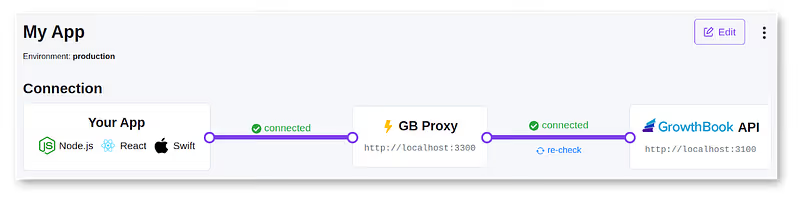
GrowthBook Proxy server architecture showing it sitting between your application and GrowthBook for speed, scalability, and real-time rollouts
The GrowthBook Proxy server sits between your application and GrowthBook. It turbocharges your GrowthBook implementation by providing extra speed, scalability, security, and real-time feature rollouts. We’ve also made substantial improvements to our JavaScript and React SDKs to better take advantage of these new capabilities. Check out the docs here — https://docs.growthbook.io/self-host/proxy
Feature flag scheduling
GrowthBook Feature Flag Scheduling UI showing timed enable and disable rules for feature flags on Pro and Enterprise plans
You can now schedule feature rules to be enabled or disabled at specific times. No more waking up at midnight to turn on a sales banner or setting calendar reminders to turn off experiments in two weeks. This feature is available on Pro and Enterprise plans.
Event-based Webhooks
GrowthBook Event-based Webhooks showing integrations with Slack, Jira, and DataDog for custom experiment and feature flag workflows
One of our goals is for GrowthBook to integrate with all of the existing tools you use — Slack, Jira, DataDog, you name it. We started this effort in the last release with our REST API and are continuing it now with Event-based Webhooks. As we expand both of these systems in the coming months, you will be able to build complex custom workflows — for example, “post in Slack every time an experiment reaches significance” or “turn off feature flag X if DataDog detects an increased error rate.”
Other features and improvements
Override metric settings on a per-experiment basis
Limit metrics and data sources to specific projects