AI coding agents and A/B testing: how to automate the experiment lifecycle
.avif)
Ideate on features, create feature flags, analyze product data, and test what you build, all from Claude Code, Cursor, or Codex against GrowthBook.
AI coding tools are reducing the cost of coding in ways no one ever imagined. Coding that used to take days now takes a prompt. But coding is just one step in the software development lifecycle. Deciding what to build, deploying safely, and tracking the impact of new features still take time. Finding ways to speed to up these processes unlocks even more of the benefits of agentic coding.
That is the vision behind GrowthBook’s 4.4. Your AI coding agent can now drive the entire experiment lifecycle against GrowthBook. From a single conversation in your editor, an agent can analyze your product data, ideate on a new feature, create the feature flag, build the variant, and test it. This post covers what that workflow looks like, how you can incorporate guardrails to create trust, and how to run it from any AI coding agent.
How AI agents can automate the entire lifecycle
Automating the lifecycle is broader than running a single A/B test. AI coding agents can now cover the full product development lifecycle:
- Analyze product data. The agent pulls product metrics and experiment data to identify new product opportunities
- Ideate. Describe a problem in plain language and have the agent propose concrete changes to try, grounded in your actual codebase.
- Create feature flags. The agent creates the feature flag and wires it into your code, so the change is rolled out gradually and safely.
- Build and test. Create experiments using templates, standardized metrics and guardrails.
- Analyze experiments and make decisions. Use AI to analyze experiment data, extract learnings, and make go/no-go recommendations.
How templates and guardrails streamline using AI to create experiments
There are many ways an experiment can go wrong, including flawed assignment rules, bad metrics, and unexpected side effects. Consistency and rigor become even more important as you scale.
GrowthBook addresses these needs in a couple of key ways. Experiment templates pre-define the metrics, randomization, and setup for a class of experiments, so the agent knows your best practices. A team can keep a template for, say, logged-out conversion tests, and every front-end experiment of that type inherits the right goal metrics and guardrails automatically. A built-in decision framework encodes when a result is genuinely shippable, rather than leaving that to the agent's guesswork. And GrowthBook stays the source of truth, so business context lives in one place instead of being re-derived in every prompt.
This is the real shift behind agentic experimentation. The agent handles the mechanics. The platform holds the judgment.
AI can apply a series of skills to automate the experimentation process
Take a simple example: testing new copy for a landing-page headline. You give your coding agent the idea in plain language and point it at the file. From there, the agent works the lifecycle:
- Ideate and build. Reads the file, proposes a few headline variants, and picks one to test.
- Configure. Finds the right experiment template in GrowthBook, confirms the metrics, and creates the experiment in draft.
- Wire it up. Creates the feature flag, links the experiment to it, and edits the component to read from the flag. Nothing is live yet.
- QA checkpoint (you). Confirm the flag is wired correctly in GrowthBook before anything ships.
- Launch. On your approval, the agent starts the experiment and tracking fires automatically as users are bucketed into variants.
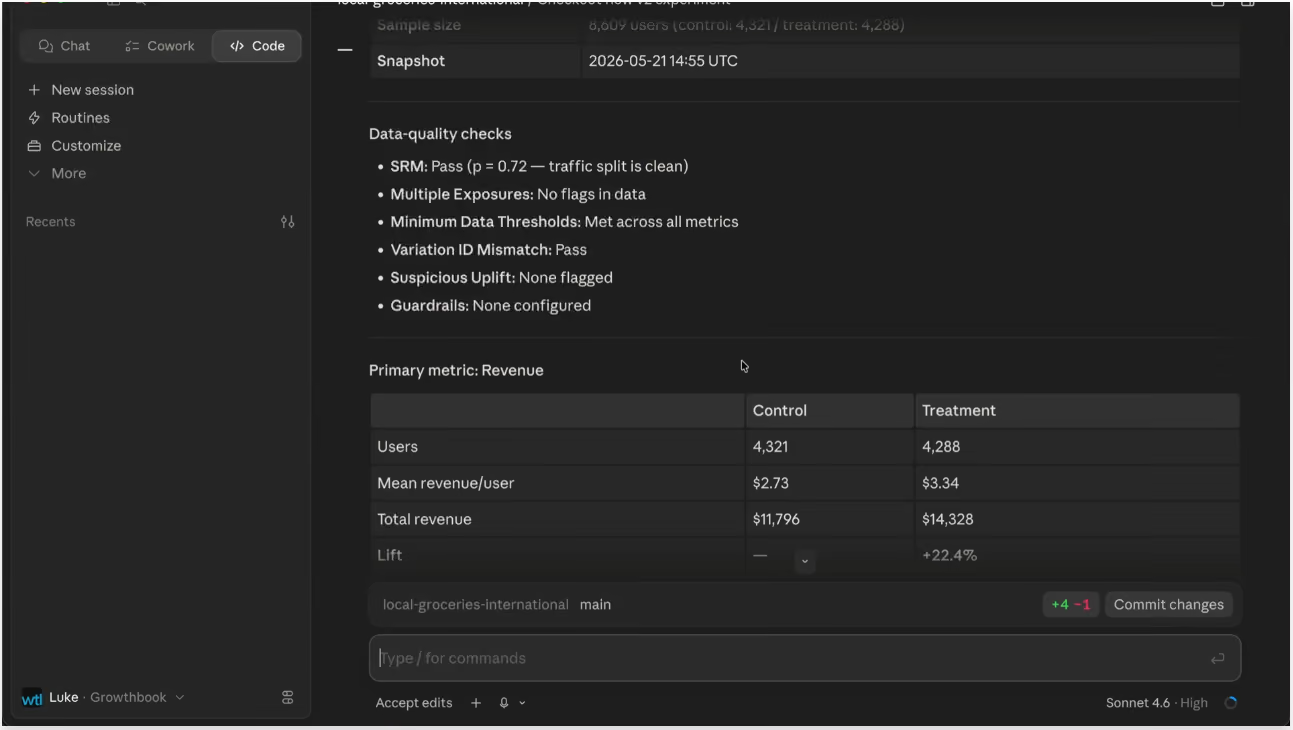
Reading and shipping work the same way. Later, you ask the agent how the test is doing:
- Analyze. Pulls the latest results, checks the test is well-powered with clean data, and summarizes what happened.
- Recommend. Because the decision framework lives in GrowthBook, the recommendation reflects your team's shipping criteria, not a generic heuristic.
- Ship (your call). If the result clears the bar, tell the agent to roll out the winner. It ships the treatment and writes up the result, with flag cleanup as an optional next step.
This works from any AI coding agent
Whether you use Claude Code, Cursor, Codex or any other coding agent, you can apply this same workflow. All the key components are coding agent-independent, including the programmatic endpoints, the CLI, and a set of open-source skills that teach an agent how to drive GrowthBook correctly. All of this then combines with the context of your own repository.
The governance layer, the templates and the decision framework and your source of truth for experiments, all work the same, consistently and safely with any tool.
The skills are open source and available on GitHub. You can use them as-is or adapt them to how your team runs experiments.
Where humans stay in the loop
Automating the lifecycle does not mean removing yourself from it. The workflow is designed around checkpoints precisely because some decisions should not be fully delegated.
QA is the clearest example. Before an experiment goes live, a person should confirm the feature flag is wired correctly and behaves as expected. Ambiguous results are another. When a test is underpowered, or a goal metric moves while a guardrail slips, that is a judgment call about tradeoffs, not a mechanical decision. The agent can surface the situation and make a recommendation, but a human should own the call.
Think of the agent as a fast, tireless operator that handles the setup, the wiring, the data pulls, and the rollout. The strategy, the QA gate, and the final ship decision stay with you.
Key takeaways
- AI made building cheap, but the experiment lifecycle stayed manual. Agentic experimentation closes that gap.
- An AI coding agent connected to GrowthBook can run the full product development lifecycle: ideate, create feature flags, analyze product data, build, and test.
- Guardrails are what make it trustworthy. Experiment templates and a built-in decision framework move judgment into the platform so agents cannot improvise metrics or ship on noise.
- It is tool-agnostic. The workflow runs from Claude Code, Cursor, Codex, or any agent, because the logic lives in GrowthBook's skills, CLI, and endpoints.
- Humans still own QA and the ship decision. The agent handles mechanics, not judgment.
Get started
The build step and the test step are now both moving at the speed of AI. The way to keep that fast loop safe is to put your experimentation structure into the platform, then let your coding agent drive against it.
The GrowthBook skills are open source and ready to try on GitHub. To see the full workflow end-to-end, watch the walkthrough video. And if you are new to GrowthBook, you can start with feature flagging and experimentation in one platform.
Related articles
.png)
Ready to ship faster?
No credit card required. Start with feature flags, experimentation, and product analytics — free.