What is an MCP server? A guide for product and engineering teams

An AI assistant can explain a rollout plan from memory. An MCP-connected assistant can inspect the real flag, check its current rules, and propose the next safe action.
That difference is the reason Model Context Protocol (MCP) matters to product and engineering teams. A language model knows patterns from training and whatever you paste into a conversation. It does not automatically know which experiments are running, which feature flags are enabled in production, or which metrics your company trusts. An MCP server gives an AI application a standardized way to discover approved capabilities and reach live systems when the task requires it.
The word server can make MCP sound like another infrastructure project. Often it is much smaller. A local MCP server may be a process that an editor starts on your laptop and communicates with over standard input and output. A remote server may expose an authenticated HTTP endpoint. In both cases, its job is the same: translate between an AI client and a system such as GitHub, Slack, a database, or an experimentation platform.
This guide explains the architecture without treating MCP as magic. You will learn what an MCP server exposes, how a request moves from a prompt to an action, why MCP is different from an ordinary API integration, and which security and governance questions teams should answer before connecting production systems.
An MCP server is an adapter for AI applications
The official MCP documentation defines servers as programs that expose specific capabilities to AI applications through standardized protocol interfaces. That definition contains 3 important ideas.
First, the server is not the model. It does not generate the answer by itself. The model runs inside a host application such as an IDE, desktop assistant, or internal agent. The host maintains an MCP client connection to the server.
Second, the server is not necessarily the underlying system of record. A GrowthBook MCP server does not replace GrowthBook. It authenticates to GrowthBook, discovers relevant workflows, and calls the platform's APIs. A database MCP server similarly sits in front of the database rather than becoming the database.
Third, the interface is standardized. A compatible client can ask a server which capabilities it offers, inspect their schemas, and invoke them without a bespoke integration for every client-server pairing. That is why MCP is often compared with USB-C: the standard defines the connection, while each attached system still decides what it can do.
Hosts, clients, and servers have different jobs
Teams often use the terms host, client, and server interchangeably. Keeping them separate makes troubleshooting and security reviews easier.
| Component | What it does | Example |
|---|---|---|
| Host application | Runs the AI experience and manages user interaction | Codex, VS Code, Cursor, or Claude Code |
| MCP client | Maintains one protocol connection inside the host | The GrowthBook connection configured in your editor |
| MCP server | Advertises capabilities and handles requests | @growthbook/mcp |
| System of record | Stores data and enforces product permissions | GrowthBook Cloud or a self-hosted GrowthBook instance |
A single host can run multiple clients, each connected to a different server. That composability is useful, but it also creates cross-server risk. An agent that can read an untrusted document and write to a production service needs tighter controls than an agent with read-only access to public documentation.
Tools, resources, prompts, and skills are related but distinct
The MCP specification describes 3 core server primitives: tools, resources, and prompts. Tools are schema-defined operations the model can request, such as listing experiments or creating a feature. Resources provide passive context, such as a schema or document. Prompts are reusable templates that guide a user through a task.
Modern agent workflows add another layer: skills. A skill is procedural knowledge that tells the agent how to combine reads, writes, checks, and approval gates into a reliable workflow. A raw API tool might technically allow an agent to update a feature flag. A cleanup skill can require the agent to inspect code references, archive first, verify behavior, and only then consider deletion.
GrowthBook's current open-source MCP package illustrates this separation. Version 2 exposes a small capability surface: list bundled skills, read a selected skill, and call the authenticated REST API. The server source describes this thin design: competence lives in the skills, while the generic API bridge supplies capability. That is a more maintainable model than shipping dozens of hard-coded MCP tools whose workflow logic drifts from the product.
Plan feature flags at scale
Learn the architecture and governance practices that keep feature flags useful as your codebase, environments, and teams grow.
Read the Feature Flag Guide
A prompt becomes an action through a controlled chain
Suppose a product manager asks, "Which checkout experiments are running, and are any guardrails moving in the wrong direction?" The model cannot answer accurately from general knowledge. It needs live context.
An MCP-enabled flow usually looks like this:
- The host sends the conversation and available capability descriptions to the model.
- The model decides that a GrowthBook workflow fits the request.
- The client asks the GrowthBook server to list or read the relevant experiment-analysis skill.
- The model follows that skill and requests read operations through the server.
- The server adds authentication and sends approved API calls to GrowthBook.
- GrowthBook applies the credential's permissions and returns current experiment data.
- The model interprets the response, cites uncertainty, and presents a human-readable summary.
If the request changes from reading to writing, the chain should become more deliberate. Starting an experiment, publishing a flag revision, or disabling a production feature changes shared state. A good skill makes that boundary explicit and asks for confirmation at the point where the intended change is concrete.
The model proposes; the system still enforces
MCP does not give a model supernatural access. The server can only expose what its implementation supports. The underlying platform can only return or mutate what the credential allows. The host can also require approval before invoking a tool.
This layered control matters. Model behavior is probabilistic, but authorization should not be. Use a personal access token or service credential with the smallest useful scope, keep environment boundaries clear, and depend on the system of record to enforce permissions. The GrowthBook MCP setup accepts a personal access token or secret key; when a PAT is used, accessible operations follow that user's permissions.
The same principle applies to the current GrowthBook skills. Discovery workflows such as flag search and metric search are read-only. Mutating workflows add explicit review points, and revision-based flag changes preserve a draft-review-publish path rather than treating a natural-language request as an automatic production change.
The response is only as trustworthy as the workflow
An MCP call can return current data and still produce a weak answer. The model may select the wrong project, confuse a draft with a live revision, summarize stale experiment results, or omit a guardrail. Reliability comes from the workflow around the call.
For high-value tasks, the skill should specify:
- which identifiers to resolve before acting
- which state to read back after a write
- which warnings block progress
- when user confirmation is required
- how to handle ambiguous project, environment, metric, or owner names
- what evidence to include in the final response
This is why product teams should evaluate MCP servers on more than their tool count. A server with 100 loosely described actions can be less useful than a thin server backed by well-tested skills and precise guardrails.
MCP and APIs solve different layers of the integration problem
MCP does not replace APIs. Most production MCP servers call APIs, query databases, or read files behind the scenes. The difference is who discovers and orchestrates those capabilities.
In a conventional integration, a developer chooses an endpoint, writes code for its request and response, handles authentication, and builds a fixed user interface. In an MCP workflow, the server describes capabilities to the AI client. The model can select an appropriate operation at runtime based on the user's request, then combine multiple operations under the host's supervision.
| Question | REST API | MCP server |
|---|---|---|
| Primary consumer | Application code | AI hosts and agents |
| Discovery | Developer reads API docs | Client lists capabilities and schemas |
| Orchestration | Encoded in application logic | Model follows instructions and skills |
| User interface | Built for each integration | Natural language in an existing AI tool |
| Authentication | Defined by the service | Passed through or mediated by the server |
| Best fit | Deterministic product integrations | Contextual, multi-step agent workflows |
The distinction suggests a practical architecture rule: keep business authority in the API and system of record, while using MCP for discovery and orchestration. GrowthBook follows that pattern. Its REST API remains the source of capability, while the MCP server and official skills make those operations usable from agent environments.
Local and remote transports change the trust boundary
Many developer-focused MCP servers use stdio. The host starts a local process, sends messages through its input stream, and receives responses from its output stream. There is no separately exposed network port. This can simplify installation and reduce remote attack surface, although the process still inherits whatever local and API access you give it.
Remote MCP uses HTTP and requires a stronger authentication and deployment story. The current MCP transport specification defines stdio and Streamable HTTP patterns. GrowthBook's version 2 server supports both. Its HTTP mode can expose a full skills-plus-API endpoint or a capability-only endpoint behind an OAuth protected-resource surface.
Remote deployment is not simply "local MCP, but hosted." You must define the public server URL, validate bearer tokens, restrict network exposure, and decide whether a single server can safely serve multiple tenants. The GrowthBook repository recommends loopback or a trusted network by default and a separate gateway or authentication layer for public or multi-tenant deployments.
Product and engineering teams need a shared operating model
The fastest path to MCP value is not connecting every system. It is choosing one bounded workflow where live context removes repeated friction.
For engineering, that might be searching flags, generating a proposed flag configuration, or reading experiment results next to the code that produced them. For product, it might be reviewing a launchable experiment spec, checking guardrails, or exploring a trusted metric without waiting for a dashboard walkthrough. GrowthBook's MCP platform page shows examples across flag creation, experiment setup, results analysis, stale-flag review, and program-level learning.
Start with read-only workflows
Read-only access gives a team room to evaluate answer quality without creating production risk. Useful first tasks include:
- list feature flags for one project and environment
- summarize the metadata for a named experiment
- search fact metrics and explain which are chartable
- inspect open flag revisions and approval state
- trace a flag's prerequisites and linked experiments
Ask reviewers to compare the answer with the GrowthBook UI. Track incorrect identifiers, missing caveats, and cases where the agent should have asked a question. These observations tell you whether the server descriptions and skills are strong enough before you enable writes.
Add writes as explicit, reviewable workflows
Once read behavior is trustworthy, add a small number of writes. A good first write is reversible and easy to verify, such as creating a disabled flag in a development project. Avoid making the first test a production kill switch or a bulk cleanup.
For every write workflow, define the receipt. A useful receipt names the project, environment, flag or experiment ID, requested action, API result, and final readback. If the platform uses draft revisions, the receipt should say whether the change is only in draft, awaiting approval, or live.
That distinction protects both roles. Product managers can describe intent in plain English, while engineering retains visibility into the exact artifact and lifecycle state. Natural language becomes an interface, not an excuse to erase change control.
Measure workflow quality, not novelty
An MCP pilot should answer operational questions:
- Did the agent resolve the right resource?
- Did it distinguish current, draft, and historical state?
- Did it stop before destructive or production-sensitive actions?
- Did it reduce handoffs or context switching?
- Could a reviewer reproduce the result from the receipt?
If the answer is no, adding more servers will compound the problem. Improve the skill, permissions, or data model first.
Security review starts with capabilities and data flow
MCP inherits ordinary software security concerns and adds agent-specific ones. A tool description or returned document may contain instructions that influence the model. Multiple connected servers can create an unintended path from sensitive data to an external write. A local package can also execute code on the user's machine.
The NSA's MCP security guidance recommends supported projects, explicit trust boundaries, least privilege, input validation, isolation, and strong control of outbound connections. Those are familiar security practices, but MCP makes it easy to overlook them because installation often looks like one command and a JSON block.
Review the server like production code
Before adoption, answer these questions:
- Who publishes and maintains the server? Prefer an official repository or a project your team can audit.
- What code runs locally? Pin or review versions when your risk model requires reproducible dependencies.
- Which credentials does it receive? Avoid broad admin tokens for routine workflows.
- Which tools and skills are exposed? Separate read-only discovery from mutations.
- Where can data flow? Include the host, model provider, server process, API, logs, and any other connected server.
- How are actions approved and audited? Make the final write and readback visible to the user.
GrowthBook's MCP server is open source and listed in the official MCP Registry. Those signals make inspection easier, but they do not replace your own credential, host, and data-handling review.
Treat retrieved content as untrusted input
Prompt injection is not limited to chat messages. A document, issue, experiment description, or tool result can contain text that tries to redirect the model. Hosts and server authors should clearly separate instructions from data, validate parameters, restrict dangerous combinations of tools, and keep humans in the loop for consequential actions.
Product teams have a role here too. Descriptions, hypotheses, and metric names should not quietly become executable policy. A natural-language request may propose a targeting condition, but a structured rule schema and review step should decide what reaches production.
Choose one closed-loop workflow to begin
MCP is most useful when it closes a loop. Reading a flag is helpful. Reading the flag, checking its code references, proposing a draft change, waiting for review, publishing the approved revision, and verifying the live state is an operational workflow.
GrowthBook's current skill library organizes work into these loops. Experiment-first work can move from design to launch, analysis, stop, and eventual flag cleanup. Flag-first work can move from creation to targeting, ramp, monitoring, and cleanup. Product analytics can move from metric discovery to a chart and then to an experiment idea. The AI-native development platform places these loops alongside feature flags and experimentation rather than treating the agent as a separate control plane.
Start with the loop your team already performs frequently and inconsistently. Document the desired states, required approvals, and verification evidence. Then connect the smallest capability set that can complete it.
An MCP server is not valuable because it lets a model call an API. It is valuable when it brings current context and safe actions into the place where a decision is being made. The protocol standardizes the connection. Your permissions, skills, and review process determine whether that connection is trustworthy.
Strengthen experiment design
Watch Ronny Kohavi and Luke Sonnet break down metric choices, trustworthy setup, and the mistakes that undermine online experiments.
Watch the WebinarRelated Articles
In healthcare, “Can we randomize it?” is the wrong first question. Start with “Could either experience change care, rights, privacy, or access?”
A/B testing can improve digital intake, appointment access, patient education, clinician workflows, and administrative operations. It can also create unacceptable risk when teams treat a clinical or consent decision like an ordinary conversion funnel.
The difference is not the label on the method. A/B tests are randomized experiments. What matters is the treatment, purpose, affected population, data flow, and oversight required in the organization and jurisdiction. This guide provides a practical product framework, not a substitute for legal, clinical, privacy, security, or institutional review.
Draw the boundary before designing variants
Create an intake step that classifies the proposed change before anyone builds a treatment. At minimum, ask:
- Can the change alter diagnosis, treatment, triage, dosage, or clinical recommendations?
- Can it delay or discourage access to care, accommodations, or urgent help?
- Does it change informed consent, privacy choice, required disclosure, or patient cost?
- Does it use protected or sensitive health information for assignment or measurement?
- Does it include children, people in crisis, or another population requiring added protection?
- Is the purpose internal quality improvement, or is it designed to contribute to generalizable knowledge?
- Could the software function fall within medical-device or clinical decision-support oversight?
The HHS quality-improvement guidance says many activities limited to improving patient care and collecting operational data are not research under the cited human-subjects regulations. It also states that some quality-improvement activities can have a research purpose, in which case human-subject protections may apply. A product team should not make that determination informally; route it to the organization’s authorized office.
Likewise, software that influences clinical decisions is not automatically an ordinary product surface. The FDA’s January 2026 clinical decision-support guidance explains that some software functions are excluded from the device definition while other patient- or caregiver-facing functions can remain subject to digital-health policy. Clinical and regulatory owners need to classify the function before experimentation.
Start with lower-risk operational questions
The safest early program tests reversible changes where both variants meet the same clinical, accessibility, privacy, and disclosure requirements.
Appointment reminder timing
Compare 2 approved reminder schedules or message structures to reduce missed appointments. Keep required details, opt-out behavior, language support, and urgent-contact instructions constant.
Use completed appointments or timely rescheduling as the primary outcome. Track cancellations, patient contacts, message delivery, opt-outs, wrong-recipient risk, and differences across language, age, disability, or access groups. A higher click rate is not enough if no-show rates or trust worsen.
Patient portal navigation
Test whether a clearer information architecture helps people complete a high-value administrative task, such as finding results, updating insurance, or sending a non-urgent message. Preserve emergency guidance and clinical escalation paths in both variants.
Measure successful task completion and time to completion. Guard against repeated navigation, abandonment, accessibility failures, mistaken message routing, and increased call-center burden. Use usability testing before the A/B test to catch failures randomization should never expose.
Administrative form sequence
Compare a long form with a staged flow, or test the order of non-clinical fields. Do not omit information needed for safe care, billing transparency, consent, or legal compliance.
Measure accurate completion, not just submission. Track validation errors, correction rates, staff rework, abandonment, and time to appointment. If the treatment collects sensitive data, confirm necessity and access controls before launch.
Educational content layout
Test 2 ways to present the same clinician-approved information: summary-first versus stepwise, text plus illustration versus text alone, or a clear action checklist versus a dense paragraph. Keep the medical meaning, risks, contraindications, and escalation advice equivalent.
Use a comprehension or appropriate next-action metric when feasible. Page time and clicks can be misleading. Accessibility, language quality, and comprehension across health-literacy levels belong in the guardrail plan.
Review the design before launch
Use a trustworthy experiment-design session to pressure-test metrics, safety checks, and decision rules before exposing patients or clinicians.
Watch the Experiment Design Session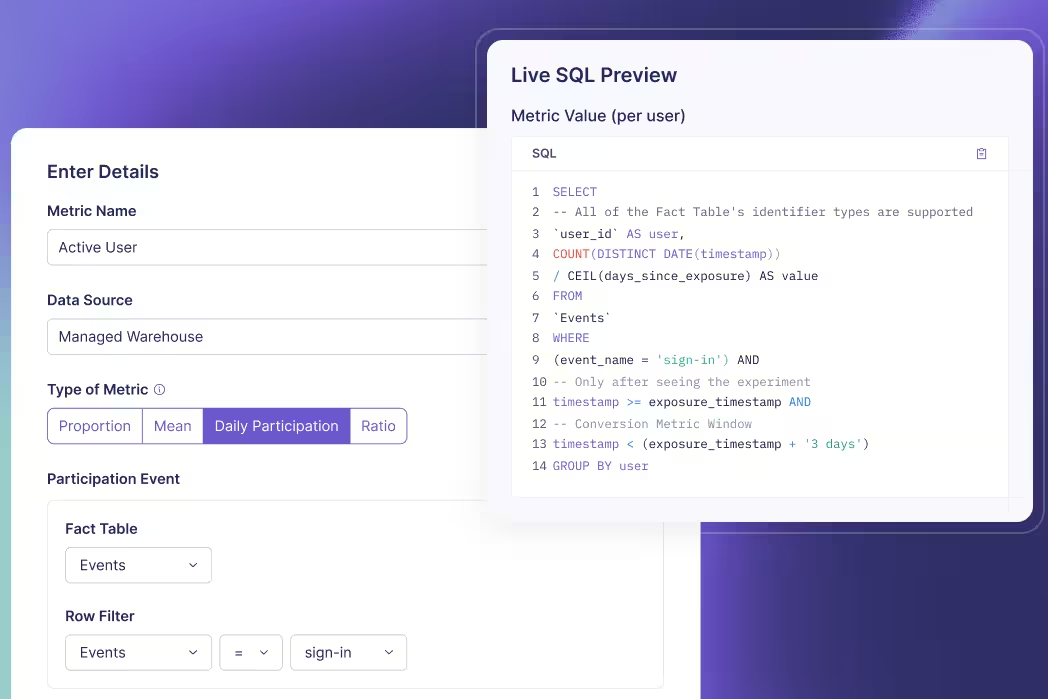
Use stronger controls for care-adjacent products
Some product changes are not clinical interventions but can still influence care. They need clinical ownership, narrower eligibility, conservative ramps, and explicit stopping criteria.
Clinician workflow support
A test might compare how a work queue prioritizes administrative follow-up, how a note template reduces documentation work, or how a non-diagnostic alert is presented. The treatment should not silently alter the clinical standard of care.
Randomize at the unit that prevents contamination. Individual clinician assignment may fail when teams share queues and handoffs; clinic- or unit-level clusters may better match the workflow. Measure task completion and time saved, with guardrails for missed work, overrides, escalations, documentation quality, and staff workload.
Preventive-care outreach
Compare approved outreach content or channels for people already eligible under the same clinical rule. Do not experiment with whether one group receives necessary care or required notice.
Use completed appropriate follow-up as the primary outcome. Track opt-outs, unreachable patients, scheduling capacity, disparities, complaints, and downstream cancellations. If the treatment drives demand beyond operational capacity, a messaging lift can make access worse.
Digital adherence support
Test the presentation or timing of an approved reminder, checklist, or educational cue. Avoid treatment changes that could be interpreted as personalized medical advice without the corresponding validation and oversight.
Measure the intended behavior with caution. Self-reported completion or app engagement is not a clinical outcome. Include adverse-event reporting, escalation pathways, disengagement, and privacy events where relevant.
Feature rollout in health software
Use feature flags to separate deployment from release, start with internal or trained cohorts, and expand only when technical and clinical guardrails remain healthy. GrowthBook’s feature flag platform supports targeted rollouts and kill switches, while the experiment layer measures impact.
The rollback plan must describe more than turning off a flag. Determine whether the old experience remains clinically and operationally safe, how queued work is reconciled, what happens to partial workflows, and who is authorized to stop exposure.
Protect data by design
Do not send a broad event stream to an experimentation vendor and decide later which fields were unnecessary. Inventory the data before implementation:
| Data question | Required decision |
|---|---|
| Assignment | What is the least identifiable stable unit that works? |
| Eligibility | Which sensitive attributes are truly needed? |
| Exposure | What event proves the treatment was delivered? |
| Outcomes | Can metrics be computed inside the governed data environment? |
| Access | Which roles can view assignments, segments, and results? |
| Retention | When are raw records, logs, and exports removed? |
The HHS minimum-necessary guidance describes limiting uses, disclosures, and requests for protected health information to what is needed for the intended purpose, with policies based on roles and recurring versus non-routine access. Apply that principle to experiment attributes, debugging logs, dashboards, and downloaded readouts.
Pseudonymous identifiers reduce exposure but do not automatically make a dataset non-sensitive or outside applicable rules. Review linkability, small cohorts, free-text fields, URLs, device metadata, and combinations that can reveal a condition. Never put clinical details or identifiers in feature names, variation labels, or URLs.
A warehouse-native experimentation approach can query approved metrics where the organization already governs them. Architecture does not create compliance on its own; teams still need contracts, access control, auditability, retention rules, security review, and configuration that matches the approved data flow.
Keep unsafe questions out of product experimentation
An experimentation policy should name prohibited or separately governed categories. Product teams should not discover the boundary only after a proposal reaches launch review.
Do not use an ordinary product A/B test to withhold a clinically indicated service, emergency direction, safety warning, accessibility accommodation, required disclosure, or legally protected choice. Do not reduce the visibility of risks to improve completion. Do not randomize a diagnostic or treatment recommendation without the clinical, regulatory, and research framework appropriate to that intervention.
Avoid treatments that exploit fear, urgency, shame, or uncertainty about health. A message can increase appointment conversion while undermining informed choice. Likewise, do not test whether patients tolerate a harder cancellation, more confusing privacy control, or hidden cost. Both variants must meet the organization’s baseline standard for respectful and comprehensible communication.
Clinical AI and decision-support changes need an evaluation program beyond a click-based A/B test. Validate the model offline, examine performance and failure modes across relevant populations, review human factors, and stage deployment with clinical monitoring. An online comparison may contribute evidence only after both treatments meet the safety threshold for exposure.
When an activity may be human-subjects research, follow the institution’s process before enrolling or exposing anyone. HHS research-oversight training states that covered non-exempt human-subjects research requires the applicable review and that informed consent requirements apply unless the IRB authorizes otherwise. The product team should preserve the determination, protocol version, approved treatment, and reporting obligations with the experiment record.
Finally, do not interpret lack of detected harm as proof of safety. Rare adverse events, small vulnerable groups, and outcomes that occur after the experiment window may be underpowered. Use prior evidence, incident monitoring, qualitative reports, and post-rollout surveillance alongside the randomized estimate.
Define patient-centered metrics and guardrails
Healthcare teams need more than a conversion scorecard. Build a measurement hierarchy:
- Primary outcome: the operational or patient-facing result that answers the decision.
- Process diagnostics: steps that explain why the treatment worked or failed.
- Safety guardrails: outcomes that trigger a stop or clinical review.
- Equity checks: predeclared groups where access or benefit could differ.
- Operational guardrails: staffing, wait time, rework, cost, and downstream capacity.
Define the practical threshold before launch. A statistically detectable change may be too small to justify implementation, and a neutral aggregate can hide meaningful harm in a protected or vulnerable group. At the same time, slicing results across many small subgroups increases false-positive risk and can expose sensitive attributes. Predeclare the equity questions that matter and use appropriate privacy and multiple-testing controls.
GrowthBook supports reusable fact tables and metrics so teams can keep definitions reviewable. Use a power analysis for the primary outcome and critical guardrails. If the required sample or duration is unrealistic, do not weaken the standard; use usability research, simulation, staged quality improvement, or a larger treatment contrast.
Create a healthcare experiment review packet
Before launch, the owner should provide one reviewable packet:
- purpose, hypothesis, and operational decision
- classification and required oversight determination
- affected population and exclusion criteria
- clinical, privacy, security, accessibility, and compliance approvals
- treatment screenshots or workflow diagrams
- assignment, exposure, and data-flow design
- primary outcome, diagnostics, guardrails, and equity checks
- sample plan and stopping rule
- rollout stages, monitoring owner, and rollback procedure
- patient or clinician communication plan, if applicable
- documentation and retention plan
Use an approval matrix that names accountable people. Product approval does not replace clinical approval; a privacy review does not settle human-subjects research status; and an IRB determination does not automatically approve the production security architecture.
The WHO clinical-trial best-practices guidance emphasizes ethical standards, regulatory considerations, patient-centered research, transparency, and stakeholder collaboration. Not every healthcare product experiment is a clinical trial, but high-risk work should inherit the same respect for people and evidence.
Build trust into the experimentation program
Start with reversible operational improvements where both experiences are already acceptable. Prove that the team can classify risk, minimize data, validate assignment, monitor safety, and document decisions before expanding scope.
Publish internal rules for what teams may test, what requires added review, and what is out of bounds. Maintain an experiment registry and audit trail. Record neutral and negative results so a new team does not repeat the same risky idea.
GrowthBook can support the controlled delivery and analysis layer through experimentation, feature flags, permissions, and warehouse-defined metrics. The organization remains responsible for the clinical, ethical, legal, privacy, and operational framework around every test.
In healthcare, speed is valuable only when the learning process protects the people whose behavior creates the data.
Build a governed test workflow
Connect controlled releases to reviewable metrics and decision rules while keeping healthcare data in your approved architecture.
Get Started With GrowthBook
The right statistical test is determined by the question and data-generating process, not by which function is easiest to run. Start with the outcome, groups, and dependence structure; the test name comes later.
Z-tests, t-tests, chi-square tests, and analysis of variance (ANOVA) all compare observed data with a null model. They differ in the kind of outcome they model, the uncertainty they estimate, and the number or structure of groups they can compare.
For a simple product experiment, a useful first pass is:
- continuous outcome, two independent groups: usually a Welch two-sample t-test
- binary proportion, two large independent groups: a two-proportion z-test is common
- categorical counts across groups: chi-square test, if expected counts are adequate
- continuous outcome across three or more groups: one-way ANOVA or Welch ANOVA
Those rules are a starting point. Paired observations, clusters, ratios, repeated measures, heavy tails, covariate adjustment, or sequential monitoring require a model that reflects the design.
Choose from the outcome and hypothesis
Write the estimand before choosing a test. An estimand is the quantity the experiment is trying to estimate: a difference in mean revenue, a difference in conversion probability, or an association between two categorical variables.
| Question | Outcome | Common test |
|---|---|---|
| Did average order value change between A and B? | Continuous | Welch two-sample t-test |
| Did signup probability change between A and B? | Binary | Two-proportion z-test |
| Is plan choice associated with variant? | Categorical, 3+ levels | Chi-square test of independence |
| Do mean task times differ across four variants? | Continuous | One-way ANOVA |
| Did the same users' scores change before and after? | Paired continuous | Paired t-test |
The number of groups alone is insufficient. Conversion in four variants is still categorical data; a chi-square or binomial model may fit. Revenue in two groups is continuous; a t-test or regression is more natural.
The University of Michigan's statistical-test guide uses the same sequence: identify variable types and the relationship being tested before selecting a method.
When to use a z-test
A z-test compares a standardized estimate with the standard normal distribution. The classical one-sample z-test for a mean assumes the population standard deviation is known. That condition is unusual in product analytics, where variability is estimated from the current sample.
Z-tests remain common for proportions. In a two-arm conversion experiment, the estimate is:
Under the null of equal proportions and with adequate counts, the standardized difference is approximately normal. This yields a two-proportion z-test.
Use it when:
- the outcome is a binary count summarized as successes and failures
- assignment groups are independent
- sample sizes make the normal approximation credible
- the hypothesis and one- or two-sided direction were set before analysis
Do not rely on a universal “n greater than 30” rule. For rare events, 30 observations can produce almost no successes; for balanced common events, approximation quality can be good. Inspect expected successes and failures and use an exact or model-based method when counts are sparse.
In high-volume online experiments, a normal approximation is also used for many sample means through the central limit theorem. The important question is whether the estimator's sampling distribution and variance calculation are valid for the metric, not whether the raw user values look perfectly normal.
When to use a t-test
A t-test is designed for inference about means when the variance is estimated from sample data. That extra variance uncertainty produces a t distribution with heavier tails than the standard normal, especially at small sample sizes.
For two independent groups, default to Welch's t-test unless equal variance is justified. Welch's version does not assume the two population variances are equal and handles unequal group sizes. NIST's two-sample t-test reference shows the unequal-variance standard error based on each group's sample variance and size.
Use an independent two-sample t-test when:
- the outcome is numeric and the mean is the target
- the two groups contain different experimental units
- observations are independent within the model
- the mean and standard error behave well enough for the sample size
Use a paired t-test when each value has a meaningful partner: the same user's before-and-after score, or deliberately matched units. The analysis reduces each pair to a difference and tests the mean of those differences. Treating paired data as independent discards information and computes the wrong standard error.
The t-test can be sensitive to extreme values because the sample mean and variance are sensitive to them. Product metrics such as revenue or session duration are often skewed. At scale, the mean may still have a usable sampling distribution, but inspect outliers, data quality, and the estimand. Robust inference, transformations, winsorization policies, or bootstrap methods may be more appropriate when a few observations dominate the result.
Reduce variance before launch
Learn how CUPED and covariate adjustment can sharpen experiment estimates without changing the randomized comparison.
Explore Variance Reduction
When to use a chi-square test
Pearson's chi-square statistic compares observed category counts with counts expected under a null hypothesis. Two common forms are:
- goodness of fit: does one categorical distribution match specified probabilities?
- independence or homogeneity: is a categorical outcome distributed the same way across groups?
Suppose an onboarding experiment records three outcomes: completed, skipped, and abandoned. Cross-tabulate outcome by variant. A chi-square test asks whether the outcome distribution is independent of variant.
The test statistic sums (observed - expected)^2 / expected across cells. NIST's chi-square documentation describes the same comparison of binned frequency distributions.
Use a chi-square test when observations contribute counts to mutually exclusive categories and expected cell counts are large enough for the asymptotic approximation. With sparse cells, combine categories only when substantively justified or use an exact method such as Fisher's exact test for a two-by-two table.
A chi-square result says the distributions differ somewhere. It does not provide the most decision-friendly effect estimate by itself. Report category proportions, absolute differences, uncertainty intervals, and the cells contributing to the pattern.
For a binary two-arm experiment, the Pearson chi-square test and a two-sided two-proportion z-test are closely related: under standard conditions, the chi-square statistic with one degree of freedom equals the squared z statistic. Choose the representation that matches the hypothesis and reporting needs.
When to use ANOVA
ANOVA compares variation between group means with unexplained variation within groups. A one-way ANOVA tests the null that all population means are equal across levels of one factor.
Use it for a continuous outcome across three or more independent groups when the global question is whether any mean differs. Classical ANOVA assumes independent errors, normally distributed residuals within the model, and equal variances. Welch ANOVA relaxes the equal-variance assumption; R's 0 implements that approximation.
ANOVA's F-test is an omnibus test. A significant result means at least one mean differs, but it does not identify which one. Use planned contrasts or multiplicity-aware post-hoc comparisons to answer the product question.
ANOVA is more than a rule for “three or more groups.” Multi-factor ANOVA can estimate main effects and interactions in multivariate or factorial experiments. Repeated-measures or clustered data need corresponding error structures rather than a basic one-way calculation.
Why several t-tests are not a substitute for ANOVA
With four variants there are six pairwise comparisons. Testing each at 0.05 creates multiple opportunities for a false positive. An omnibus ANOVA tests one global null first, and planned follow-ups can use Tukey, Holm, Bonferroni, or another procedure appropriate to the family of claims.
The Bonferroni correction is simple and conservative. The right procedure depends on whether the goal is all pairwise comparisons, treatments versus one control, or a small set of preplanned contrasts. Define that family before looking at the ranking.
ANOVA and regression are also two views of the same linear-model machinery. R's 0 documentation describes aov as a wrapper around linear models for experimental designs. Regression is often more flexible when the analysis includes covariates, interactions, or unbalanced data.
Assumptions that change the choice
Before running any of the four tests, verify:
Independence and assignment unit
If the experiment randomizes accounts but analyzes users as independent observations, standard errors will usually be too small. Analyze at the randomization unit or use cluster-aware inference. If users can appear in both groups, repair the assignment or use a model that represents the dependence.
Paired or repeated observations
The same user measured twice is not two independent users. Use a paired test or repeated-measures model. For experiments with many events per user, aggregate to the user level or use appropriate clustered methods.
Outcome distribution and metric construction
Check missingness, zero inflation, extreme tails, ratio denominators, and censoring. A test can be mathematically correct for the supplied numbers while the metric itself misrepresents the user outcome.
Variance assumptions
Prefer Welch's t-test or Welch ANOVA when group variances may differ. Equal sample sizes do not prove equal variance, and a preliminary variance test can introduce another decision layer.
Sample size and sparse cells
Approximate z and chi-square methods need enough information in the relevant cells. Low-frequency guardrails and small segments may need exact methods or longer collection.
A product experimentation decision tree
Use this sequence before opening a statistics package:
- What unit was randomized: user, account, device, session, or region?
- What is the primary estimand: mean, proportion, category distribution, or model coefficient?
- Are groups independent, paired, repeated, or clustered?
- Are there two groups, several groups, or multiple factors?
- Do expected counts and sample sizes support the approximation?
- Are variances, tails, or outliers likely to break the default model?
- How many confirmatory hypotheses can trigger the decision?
- Was the test direction and stopping rule declared before launch?
Then choose the simplest model that answers the exact question. A two-proportion z-test may be perfect for signup conversion, while a t-test handles mean revenue and a chi-square test handles plan mix in the same experiment. Different metrics can require different tests.
Report effects, not only test names
The test produces a statistic and p-value under a null model. The guide to interpreting a t-test p-value shows why that number needs the effect, interval, and degrees of freedom beside it. The product decision needs more:
- the effect estimate in business units
- a confidence or credible interval
- sample sizes and allocation
- baseline and treatment values
- assumption and data-quality checks
- the planned hypothesis family
- practical thresholds and guardrails
GrowthBook's statistics documentation explains the frequentist and Bayesian engines available for experiment analysis. Whichever framework is used, review effect magnitude and uncertainty together. A small p-value can accompany a trivial lift in a huge sample, while a valuable estimated lift can remain uncertain in a small one.
Choose the test by tracing the data back to the experiment design. For three or more continuous-outcome variants, the deeper ANOVA guide covers the omnibus F-test, planned contrasts, and Welch alternative. When the outcome, assignment unit, dependence, and hypothesis are explicit, the difference between z, t, chi-square, and ANOVA becomes a modeling decision rather than a memorization exercise.
Analyze tests with context
Connect experiment assignments to trusted metrics, inspect uncertainty, and keep decision rules visible to the whole team.
Get Started With GrowthBookAn experiment with control plus three variants creates more than one comparison. ANOVA gives the team one principled global test of whether the variants differ before it starts hunting for a winner.
Analysis of variance, or ANOVA, is a family of statistical models for comparing group means and decomposing sources of variation. In a one-way product experiment, the “factor” is the assigned variant and its “levels” are control, B, C, and D.
The basic ANOVA question is deliberately broad: if all variants had the same population mean, would the observed separation among their sample means be surprising relative to the noise within variants?
That question is useful, but incomplete. A significant ANOVA result does not say which variant won, whether the lift is large enough to ship, or whether assumptions and instrumentation are sound. Those conclusions require planned contrasts, uncertainty intervals, and experiment-quality checks.
How ANOVA compares means through variance
ANOVA separates total variability into components:
- between-group variation: how far each group mean is from the overall mean
- within-group variation: how far individual observations are from their group mean
Each sum of squares is divided by its degrees of freedom to produce a mean square. The F statistic is:
Under the null hypothesis that all group means are equal, both quantities estimate the same underlying error variance, so their ratio should often be near 1. When group means are separated relative to the residual noise, F grows.
NIST's one-way ANOVA explanation describes this as comparing the level mean square with the residual mean square. The p-value is the probability, under the null model and assumptions, of an F statistic at least as large as the observed one.
For k groups and N total observations, one-way ANOVA usually has:
The numerator asks how much the k means vary. The denominator pools information about variability inside the groups.
A four-variant experiment example
Suppose a SaaS team tests four onboarding flows and measures projects created per eligible account during the first week.
| Variant | Accounts | Mean projects | Standard deviation |
|---|---|---|---|
| Control | 1,000 | 2.30 | 1.80 |
| B | 1,020 | 2.42 | 1.84 |
| C | 990 | 2.61 | 1.91 |
| D | 1,010 | 2.36 | 1.79 |
The null hypothesis is:
The alternative is that not all four means are equal. Notice what it does not say: “C is best.” The global alternative includes any pattern where at least one mean differs.
If the F-test rejects the null, the team should evaluate the comparisons it planned. It might compare every treatment with control, or test one contrast between the current flow and the average of three new concepts. The comparison plan should reflect the decision, not the visual ranking in the finished dashboard.
Make multiple tests trustworthy
See how experimentation leaders plan hypotheses, guardrails, and review practices when a result surface contains many possible claims.
Watch the Trustworthy Experiments TalkWhy not run every pairwise t-test?
Four groups create six pairs. If the team runs six independent tests at alpha 0.05 and treats any significant result as proof, the probability of at least one false positive across the family can exceed 0.05.
ANOVA gives one global test of the equality of all means. It also estimates residual variation using all groups, which can be more efficient than estimating it afresh for each pair under the classical equal-variance model.
The global test does not eliminate multiplicity in follow-up comparisons. R's Tukey HSD documentation explicitly notes that ordinary t-tests inflate the probability of a false declaration across a family. Choose the follow-up procedure for the comparisons the decision actually needs:
- every pair: Tukey-style simultaneous comparisons
- every treatment versus control: Dunnett-style comparisons
- a few planned product questions: predeclared contrasts with a suitable adjustment
- a conservative small family: a Bonferroni or Holm correction
An omnibus test can also be nonsignificant while one carefully planned contrast is persuasive, because the hypotheses and power differ. Decide before launch whether the global null or a treatment-versus-control contrast is the primary decision test.
Unequal group sizes do not automatically invalidate ANOVA, but they make the variance assumption and contrast plan more consequential. If allocation is intentionally uneven, power the smallest comparison that drives the decision and preserve the assignment probabilities. When variances and sample sizes both differ, classical pooled ANOVA can behave poorly; Welch ANOVA or a regression with suitable standard errors is usually easier to defend.
Planned contrasts can also use product structure that the global test ignores. Instead of comparing every pair, a team might compare control with the average of three related treatments, or compare two low-intensity treatments with two high-intensity treatments. A small set of predeclared contrasts often answers the business question with more power and clearer multiplicity control than an exhaustive winner search.
ANOVA assumptions in experiments
The familiar one-way fixed-effects model can be written as:
Classical inference depends on the residuals and design, not on a requirement that the combined raw outcome form one bell curve. NIST's model reference assumes independent, normally distributed errors with mean zero and common variance.
Independent observations
The analysis unit must respect randomization. If accounts are assigned but every user within an account is treated as independent, the standard error ignores clustering. Aggregate at the account level or use cluster-robust or hierarchical methods.
Repeated events from one user create the same problem. Ten sessions from one user do not carry the same independent information as ten users.
Appropriate residual behavior
ANOVA is often robust to moderate non-normality with balanced, sufficiently large groups, but severe skew, outliers, censoring, or zero inflation can make the mean unstable or the F approximation unreliable. Diagnose residuals and assess whether the mean is still the business estimand.
Equal variance for classical one-way ANOVA
Classical ANOVA assumes a common population variance. This can fail when a treatment changes both the mean and spread, or when groups serve different traffic mixes. Unequal group sizes make the problem more consequential.
SciPy's 0 supports Welch ANOVA when equal_var=False. Welch's method relaxes equal population variances and adjusts the degrees of freedom.
Correct outcome model
ANOVA targets a continuous mean. Conversion is binary; event counts are discrete; time-to-churn can be censored. Large-sample mean inference can sometimes work, but logistic, Poisson or negative-binomial, survival, or other generalized models may better represent the outcome and produce interpretable effects.
One-way, two-way, and repeated-measures ANOVA
“ANOVA” names a family rather than one calculation.
One-way ANOVA
One categorical factor with multiple levels, such as four assigned onboarding variants. This is the usual A/B/n example.
Two-way or factorial ANOVA
Two controlled factors, such as headline and layout. The model estimates each main effect plus their interaction. The interaction asks whether one factor's effect changes with the other. This is central to a properly designed multivariate test.
Repeated-measures ANOVA
The same units are observed under multiple conditions or times. Dependence is part of the design and must be modeled. A basic independent one-way ANOVA is invalid for repeated measurements.
ANCOVA
Analysis of covariance adds continuous covariates to the group comparison. In randomized experiments, pre-experiment covariates can improve precision when they are chosen and measured without post-treatment contamination. GrowthBook's guide to variance reduction explains the same motivation in online experimentation.
Run one-way ANOVA in Python
At the action boundary, keep one numeric observation per independent analysis unit in each group. In SciPy:
Before running it, confirm that rows match the randomization unit and missing values have a documented policy. Afterward, inspect group summaries and residual behavior. The p-value alone cannot reveal a broken exposure join or a few enormous outliers.
In R, aov(outcome ~ variant, data = experiment) fits the classical model. R documents 1 as a linear-model interface, which helps explain why ANOVA, regression, and contrasts are closely connected.
Interpret the ANOVA table
A standard output contains:
- degrees of freedom
- sum of squares
- mean square
- F statistic
- p-value
Suppose the output reports F(3, 4016) = 6.8, p < 0.001. Under the model, the observed ratio of between-variant to within-variant variation is unlikely if all four population means are equal. It does not mean every treatment beats control or that any effect is commercially important.
Add the quantities the product decision needs:
- each mean and sample size
- differences from control in original units
- simultaneous or comparison-specific intervals
- an effect-size measure when useful
- guardrail and data-quality results
- the follow-up comparison method
Avoid ranking noisy means without uncertainty. The highest observed variant has benefited from both its true effect and sampling variation, especially when many variants were screened.
Common ANOVA mistakes
Treating events as independent users
Repeated events make the nominal sample size huge and uncertainty too narrow. Preserve the assignment unit.
Using ANOVA for every metric shape
The word “variant” does not imply ANOVA. Match the outcome distribution and estimand to a model.
Checking assumptions after selecting a winner
Write the model, outlier policy, transformation, and variance choice before the ranking is visible. Result-driven switching creates hidden researcher degrees of freedom.
Treating a significant F-test as a winner declaration
Follow with the planned contrasts. The omnibus test only rejects equality of all means.
Ignoring practical significance
A very large experiment can detect a tiny difference. Compare intervals with a minimum practical effect and account for implementation cost and guardrails.
Use ANOVA as part of an experiment plan
Before launch, specify the factor and levels, independent unit, primary continuous outcome, minimum effect, sample-size plan, variance assumption, global or contrast hypothesis, comparison family, and stopping rule.
Then verify assignment and exposure before interpreting the model. A sample ratio mismatch can signal that observed group counts no longer reflect the planned randomization. No F-test can repair biased exposure data.
ANOVA is valuable because it turns a field of variant means into a structured model of signal and noise. The broader z-test, t-test, chi-square, and ANOVA guide shows when the outcome and hypothesis call for another member of that family. Use the omnibus test for the global question, planned contrasts for the decision, and effect estimates for practical judgment. That sequence makes a multiple-variant test easier to defend than a dashboard full of uncoordinated p-values.
Compare variants with discipline
Run controlled experiments, connect trusted metrics, and review treatment effects and uncertainty in one shared workflow.
Start With GrowthBookReady to ship faster?
No credit card required. Start with feature flags, experimentation, and product analytics—free.