Unlock more learning with every experiment
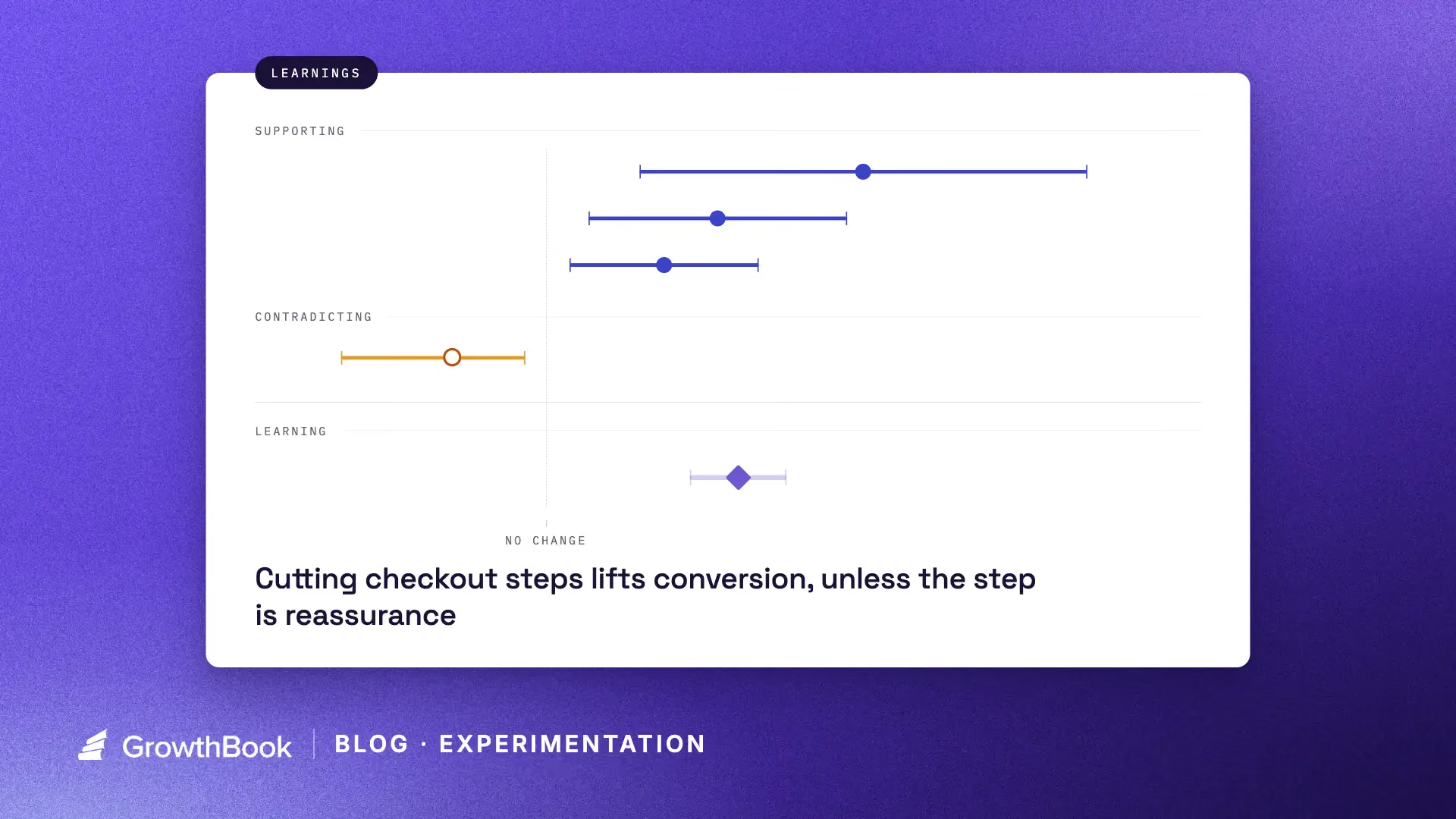
Running an experiment gives you an answer to a question. Running thousands of experiments gives you a lot of answers, but also something much more valuable: a body of evidence about how your product, users, and business actually behave.
The problem is that this knowledge is surprisingly difficult to use in practice.
A PM working on onboarding might not know that another team tested a similar idea six months ago. An engineer building a new checkout flow might not know which patterns have consistently helped conversion on other parts of the product. Even when people remember that relevant experiments exist, reading through dozens or hundreds of them to find the important patterns is rarely practical.
Today, we are launching Learnings in GrowthBook to help solve this problem.
Learnings let teams capture what they have learned across experiments, user research, and other sources of evidence, then make that knowledge available to both people and AI agents when they are building something new.
Experiments produce more than winners
The most obvious output of an experiment is a decision. Those decisions create incremental gains, and over time those gains compound.
But there is another output from experimentation that is easier to overlook: knowledge. Every experiment produces it, including the ones that lose or move nothing at all.
You might learn that:
- Showing pricing earlier in the funnel consistently improves qualified conversions.
- Simplifying onboarding helps new users but hurts activation for experienced users.
- Social proof matters on acquisition pages but has little effect inside the product.
- Asking users to configure everything upfront creates friction, while progressive configuration performs better.
None of these conclusions necessarily come from a single experiment. They emerge after five, twenty, or a hundred experiments, once somebody notices the pattern.
This is where an experimentation program becomes more powerful than a sequence of isolated A/B tests: individual tests give you answers, but the program gives you a model of how your users behave. You are gradually identifying patterns and putting your learnings to work for future growth.
Learnings compound your experimentation program
If an experiment improves conversion by 2%, that improvement can continue generating value for as long as the change remains in the product (novelty effects aside). That’s real compounding, and it’s the return most programs measure.
But that win only compounds one thing: a metric. A learning acts on something different: the quality of the next decision.
Imagine your team learns through repeated experiments that users perform better when complex actions are introduced progressively rather than all at once. That insight might influence your next onboarding flow. Then your settings experience. Then a new AI feature. Then the way an agent designs a workflow six months later.
It doesn’t stay with one team either. An insight can travel to whoever picks your onboarding feature or settings work next. Your experimentation program can widen, since everyone starts from organizational knowledge.
The value is not limited to the experiment that produced the learning. It changes the starting point of future work. Instead of beginning every project from first principles, your team starts with a set of evidence-backed assumptions about what tends to work (and what doesn’t).
Learnings in GrowthBook
GrowthBook Learnings are designed to capture this organizational knowledge explicitly.
A learning can reference evidence from multiple experiments, rather than being tied to the result of a single test. That matters because many useful conclusions only become visible across a collection of experiments.
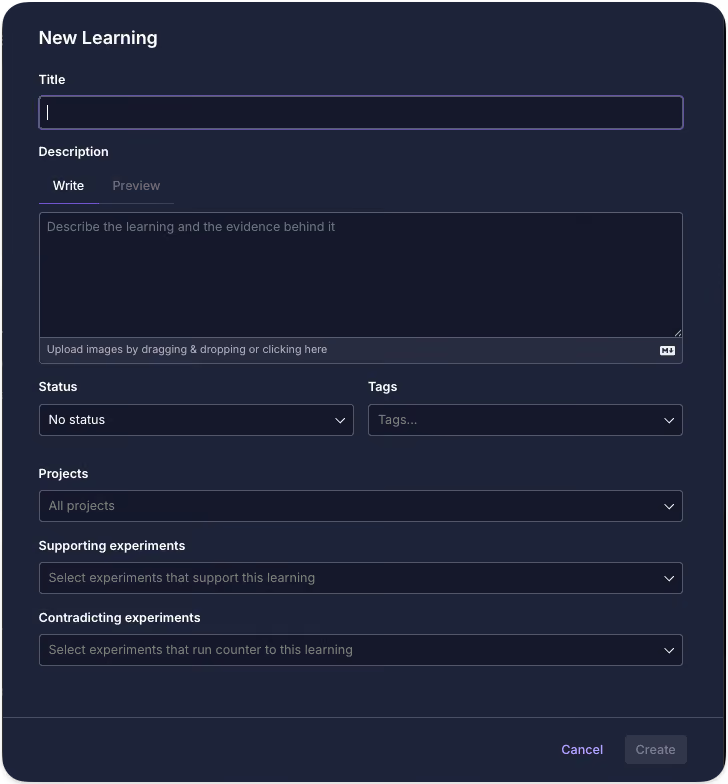
You can use Learnings to document things like:
- Patterns that repeatedly improve a metric
- Approaches that consistently fail
- Differences between user segments
- Design principles supported by experimentation
- Unexpected behaviors observed across multiple tests
- Areas where the evidence is contradictory or uncertain
The same change isn’t universally applicable, though. Streamlining a flow can lift conversion in one part of your product and lower it in another, and the right amount of friction depends on what the user is trying to do. Learnings can be scoped to specific projects or tags, so that patterns that have been tested for your self-serve signup aren’t applied to your enterprise onboarding flow.
And learnings do not have to come exclusively from experiments either. You can capture qualitative findings from user research, customer interviews, support conversations, or other sources and combine them with quantitative evidence.
The goal is not to turn every observation into an immutable rule.
It is to give your organization a shared, evidence-backed memory. Each learning can be updated if new evidence comes in, and also have a specific status for when the learning is not verified yet, or if it’s no longer relevant. Statuses for learnings are entirely customizable. Once captured this way, that memory becomes something both people and AI agents can draw on, which raises the question of how much of it to hand an agent at once, and in what form.
The context window problem for organizations
There is a useful analogy to working with AI coding tools.
If you give an agent every line of code your company has ever written, you have technically given it more information. But you have not necessarily given it better context.
The useful question is: what does the agent actually need to know to make this decision well?
Organizations have the same problem. After thousands of experiments, nobody should need to read thousands of experiment reports before starting a project. They need the relevant conclusions.
Learnings act as a compressed context layer over your experimentation history. The underlying experiments are still there as evidence, but people and agents can work from the higher-level patterns that those experiments have established.
For example:
Learning: Users are more likely to complete complex setup flows when advanced configuration is deferred until after initial success.
Evidence: Seven onboarding experiments across three product areas.
A PM planning a new onboarding experience can start with that knowledge instead of rediscovering it. An engineer can incorporate it while designing the implementation. The same applies to agents, even more strongly. An agent without access to your evidence will still produce a confident answer, but it will be generic and maybe an approach you’ve already disproved. Point your agents at your Learnings, and they start from what you already know.
Learnings are available through GrowthBook's APIs and MCP support, just like your experiments and other experimentation data. Through GrowthBook Skills, you can instruct agents to retrieve relevant Learnings before they design or implement something.
Instead of giving agents generic product-development best practices, you can give them exactly what they need to know to make this decision well: your company’s own compressed, decision-relevant knowledge, grounded in real outcomes and updated as new evidence comes in.
AI can help find the patterns humans miss
As experimentation programs grow, manually identifying patterns becomes harder if not impossible. A team running ten experiments a year can probably remember most of them. A company running thousands cannot. GrowthBook can use AI to analyze your experiment history and surface commonalities across results.
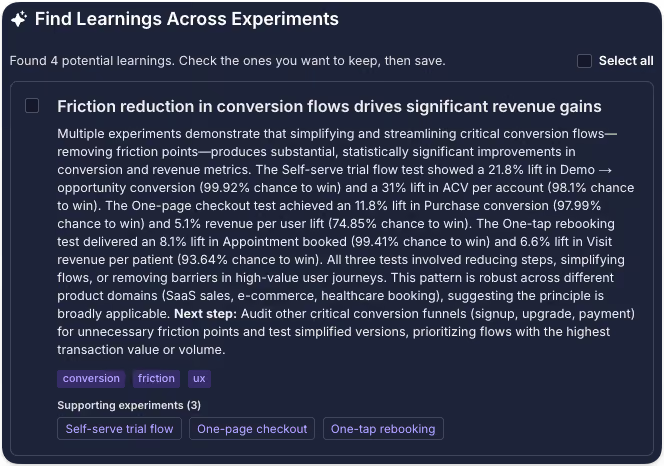
Perhaps a certain type of messaging consistently works for new users but not existing customers. Maybe several unrelated experiments show that reducing perceived commitment improves activation. Maybe a UI pattern that teams keep proposing has actually failed in four different areas of the product.
These patterns are easy to miss when every experiment is analyzed independently.
AI makes it possible to search across a much larger body of evidence, while Learnings give teams a place to review, refine, and preserve the conclusions that matter.
Good experiment hygiene becomes even more valuable
There is an important prerequisite.
AI cannot infer very much from an experiment called "Homepage test 7" with no hypothesis, description, or conclusion.
The better your experiment documentation, the more useful your accumulated knowledge becomes.
This is one reason GrowthBook has increasingly invested in experiment quality and hygiene, including checklists and workflows that encourage teams to document the hypothesis, context, results, and conclusions of an experiment. Good documentation has always made individual experiments easier to understand.
With Learnings, it also makes the entire experimentation history more valuable. Every well-documented experiment becomes another piece of evidence that can contribute to future decisions.
From experimentation history to organizational memory
The long-term value of experimentation is not just making better decisions today. It is making every future decision from a stronger starting point.
Experiments that win improve the product. All your experiments improve the ideas, assumptions, and decisions that come next, increasingly including the ones your agents make. That’s the part that really compounds. Firmer footing leads to better experiments, which produce better evidence, which produces better judgment. Over time, your experimentation program is not only improving your product, it’s improving your organization’s ability to build one.
Experiments should not disappear into a results archive once a decision has been made. The best ones should keep teaching you.
Related articles
.png)
.png)
Ready to ship faster?
No credit card required. Start with feature flags, experimentation, and product analytics — free.