What teams really want when they build an in-house experimentation platform

You’re reviewing a test of a new listing flow for sellers.
Revenue per seller is up. The marketplace lead knows a handful of shops do most of the business. “Did we help more sellers make a sale,” she asks, “or did one big shop have an unusually good week?”
The analyst wants the query behind the chart. For a start, she’d like to see whether sellers who made zero sales were included in the average. The dashboard gives her a number. Getting the SQL means opening a support ticket. Someone in the room says, “We should build our own.”
I get the impulse. Your team needs to be able to answer that question before it ships the new flow. How much of an experimentation platform do you need to own to do that?
What teams mean by “let’s build it”
When you unpack a proposal to bring experimentation in-house, four requests tend to show up.
Let us choose when the evidence is good enough. At The Knot Worldwide, the data team and its vendor used different criteria for stopping a test. Product managers could get one answer from the tool and another from their own analysts. When the team built Gecko, it could put its own decision criteria in the tool everyone used.
Let us ship a capability when we need it. Adevinta had ten A/B testing tools across 22 marketplaces. Its plan to consolidate them made room for a vendor during the transition while its engineers kept developing their own platform. They wanted a say in which features got built and how the system would scale across markets.
Let the platform fit the business. In a study of in-house experimentation platforms, Nils Stotz and Paul Drews found that teams built to meet requirements specific to their products, compliance obligations, and workflows. For Upstart, that meant keeping sensitive financial data on its own infrastructure. A long list of statistical features wouldn’t make up for a deployment model its security team couldn’t use.
Let us check the answer. Back in the marketplace review, suppose the query starts from the orders table. A seller who never got an order has no row. To measure revenue per exposed seller, you want to start with all the sellers who saw a variation, join their orders, and count zero revenue for anyone who sold nothing. An analyst with the SQL can check which calculation the team is looking at.
Those are good reasons to want control. None requires you to write the code that assigns a seller to a variation or calculates a confidence interval.
The build has a finish date. Maintenance doesn’t.
One of our customers, a large AI company, had a mature experimentation platform its teams were happy with. They’d built it themselves. The trouble started well after launch, when fewer engineers were available to work on it. New features stopped shipping. Keeping the platform running took up the time the remaining engineers needed to pay down its technical debt.
By the time the company moved to GrowthBook, it was spending more to keep its old platform running than it would cost to buy one that already offered the capabilities its teams were waiting for. Its engineers had done a good job building the platform they needed at the time. What changed was how much engineering time the company could keep giving it.
Upstart put numbers on that commitment. It already had two homegrown experimentation tools and a third-party flagging tool. The team estimated a new build would take four engineers in year one and at least two engineers each year after that.
There’s also the cost of finding out the system was wrong. GrowthBook co-founder Graham McNicoll wrote in 2020 about a basic platform he helped build at a previous company. It took about a month. Some bugs went unnoticed for months, and the team had to throw out the affected tests.
If you’re estimating a build, include the statistician who’ll review the analysis, the person who’ll build a UI a product manager can use, and the engineer who’ll keep the mobile and server SDKs in sync. Someone also owns the cache when a flag update doesn’t arrive and the audit trail when you need to know who changed it. Those jobs will still be there next year.
See what you’d self-host
GrowthBook packages its app and stats engine in one Docker image. Walk through the setup to see what your team would run alongside its existing warehouse.
Read the Self-Hosting Guide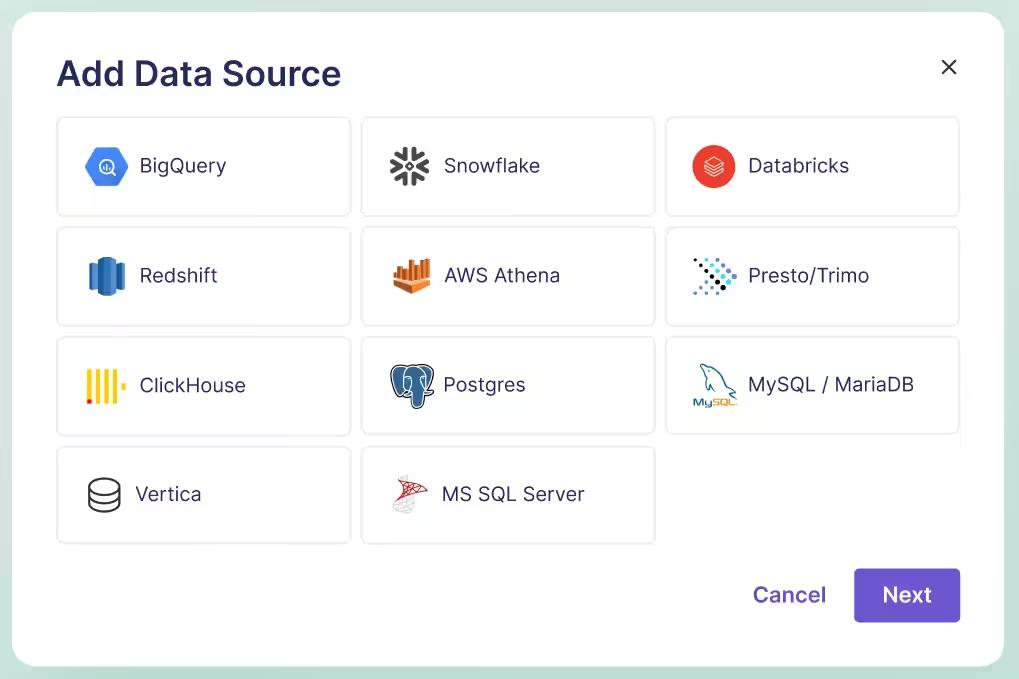
Buying puts someone else in charge of the roadmap
Buying has a long-term cost of its own. You can get everything on your requirements list today and still have limited say in what happens to the product next year.
In September 2025, OpenAI announced its acquisition of Statsig. In May 2026, Amplitude announced a partnership to take on the Statsig brand and customers and continue developing and supporting the platform. A customer could welcome both announcements. In the space of eight months, the same team with the same experiments had a new company to talk to about its roadmap.
The question I’d ask any vendor is specific. If we need a change you aren’t planning to build, what can our engineers do on their own?
Open source gives you a third option
“We give you build-level control without owning the codebase, the on-call, or the roadmap.”
With GrowthBook, you can start by reading the same statistics code that produces your results. If an integration you need is missing, your engineers can write it. And if your plans and ours diverge far enough, the MIT license on the core lets you keep a copy and change it. In the words of our guide to open-source feature flags, “you fork it and keep going.” Enterprise features have a separate commercial license.
You also choose where GrowthBook runs. A team with data residency requirements can run it in its own infrastructure, including in an air-gapped environment. If you self-host, the upgrades, backups, and on-call for that deployment are yours. With managed Cloud, GrowthBook runs the service. Either way, you can inspect how a result was calculated.
Where GrowthBook bends to fit your program
Your data and metrics
For that seller experiment, your data team can define the metric in SQL on the warehouse tables it already trusts. Use the same definition of a completed order that finance uses, including its treatment of refunds. If the marketplace lead asks how many sellers made any sale, you can add that metric mid-experiment and look back over existing exposures and orders. You need to have recorded both. Treat the new measure as a follow-up question and keep your original success criterion visible.
Your statistics
Pick a Bayesian or frequentist analysis and agree on a stopping rule before launch. If last month’s seller revenue is a good predictor of this month’s, CUPED can use that history to reduce noise. For a frequentist test where you plan to check results along the way, you can enable sequential testing. A bandit serves a different goal. It shifts traffic toward better-performing variations as evidence comes in.
When a result looks odd, open the warehouse query to see how it selected sellers and matched them to orders. Then inspect the statistics code to see how GrowthBook turned those inputs into an estimate and its uncertainty.
Your stack
GrowthBook has 24+ SDKs. Once flag definitions are loaded, an SDK can evaluate a flag locally. Your checkout can choose a variation without waiting for a round trip to GrowthBook on each check. You can serve definitions from your own CDN, back the GrowthBook Proxy with Redis, or evaluate flags in an edge worker if that’s where you already handle the request.
Your workflows
Say the release team wants flag changes to appear in an internal deployment log. Subscribe to webhook events and have your service write the entry. The REST API lets tools you already own manage experiments and flags. Teams that work in Terraform can evaluate a community-maintained provider. Developers who use OpenFeature can keep its flag evaluation interface. An engineering assistant can use the MCP server to look up an experiment from the editor.
Your governance
A team testing copy in a development environment and a team changing the production checkout may need different sign-offs. With Enterprise, you can use role-based permissions, required approvals, and audit logs to give people room to work in development, require a reviewer for production flag changes, and see who approved the change afterward.
How Treatwell put the pieces together
Treatwell connects customers with more than 75,000 salon partners across 15 countries, processing over five million bookings a month. Its teams used to compare what happened before a release with what happened afterward. If more people finished booking, it was hard to tell how much credit the new checkout deserved.
Treatwell already had an event pipeline through mParticle and a warehouse in Amazon Redshift. “GrowthBook’s ability to connect directly to our data warehouse was a key differentiator,” said Marek Maciusowicz, Head of Engineering for Marketplace and Payments.
| What Treatwell needed | What it would have to build | How Treatwell covered it |
|---|---|---|
| Run tests within product teams | A way to assign variants and share results with product and data | Engineers ran randomized tests behind feature flags. Product managers set the hypothesis and target metric. |
| Use existing data and keep control of it | Analysis that worked with its Redshift tables and privacy requirements | Treatwell chose the self-hosted data model and connected GrowthBook directly to Redshift. |
| Test changes across web and mobile | Compatible assignment logic across its apps and services | Teams used the Java, React, Swift, and Kotlin SDKs. |
| Adopt one team at a time | A rollout path that could support early teams while others kept working as usual | Treatwell chose a setup it could adopt gradually. All three marketplace engineering teams now use it. |
One test removed a step between checking a staff member’s availability and going to checkout. Some people on the team worried customers might advance accidentally and drop out. Checkout conversion went up. That’s the kind of decision Treatwell wanted its product teams to be able to make for themselves.
Key takeaways
- Ask which decisions your team needs to own. A stopping rule, a metric definition, and a missing integration are three different engineering problems.
- Price an internal platform through its second year. Include the people who’ll maintain it while the rest of engineering moves on.
- Ask who can keep a critical feature working if a vendor changes hands or priorities.
- An open-source core gives you a place to start and the right to change it. You can keep your investment in the parts that are specific to your business.
What would you build first?
Kris has a rule of thumb I like. “You should always build what differentiates, and buy what accelerates.”
Before you scope the platform, write down the three to five things you’d want from a custom build. Be specific enough to test one. Can an analyst reproduce revenue per exposed seller, including the sellers who sold nothing? Can a product team launch a checkout test with the right approval in place?
Take the hardest item and try it in GrowthBook. If the missing piece is your own metric, model, or integration, that’s a good place to put an engineer. It’s a much smaller first project than building the system that runs every experiment.
Try your hardest metric
Connect your warehouse and recreate a metric you already trust. For revenue per seller, check whether sellers with no orders still count in the average.
Get Started With GrowthBook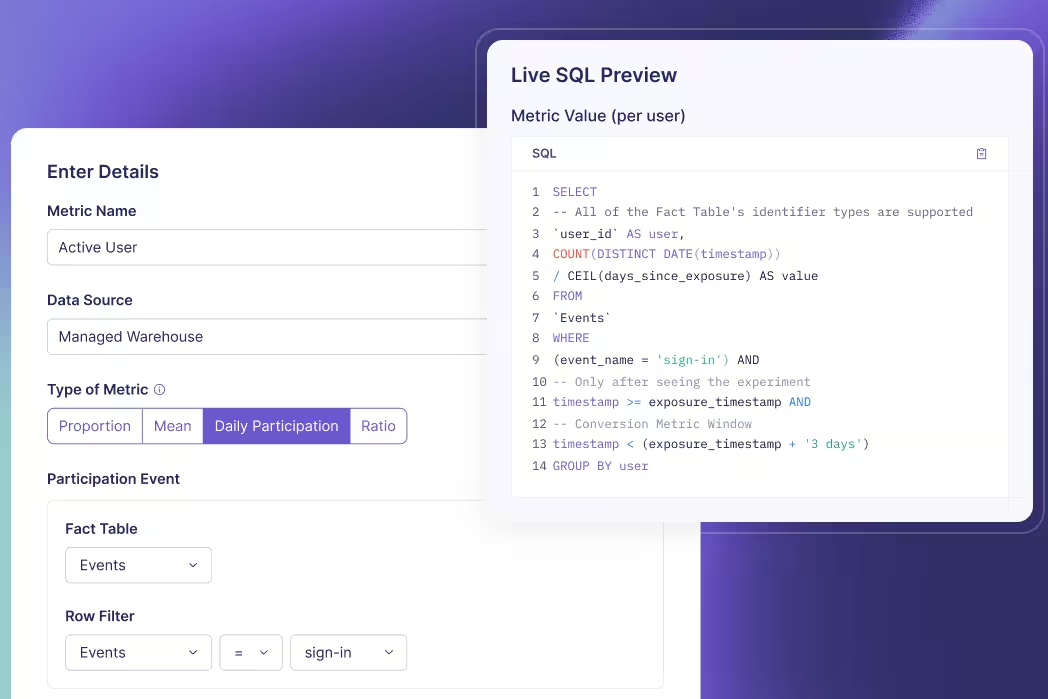

Get The Uplift in your inbox
Experimentation tips and a new game, once a month.

Related articles


Ready to ship faster?
No credit card required. Start with feature flags, experimentation, and product analytics — free.