Dropbox Streamlines Experimentation and Cuts Costs with GrowthBook
Dropbox is a cloud-based file storage and collaboration company based in California, designed to help individuals and teams securely store, sync, and share files. It serves over 700 million registered users worldwide.
“Our goal was to consolidate everything into a single platform while saving money and ensuring compliance and security”


Overview
Dropbox, a global leader in cloud storage and file synchronization, faced challenges maintaining a cohesive experimentation platform as the company expanded through acquisitions. With multiple tools in place, inefficiencies and fragmentation emerged. To address this, Dropbox is in the process of unifying its feature flagging and experimentation by adopting GrowthBook, a scalable and flexible solution that fits its complex infrastructure.
.png)
Challenge
Dropbox’s experimentation infrastructure became increasingly complex and costly with each acquisition. Managing multiple platforms, including its internally developed system, Stormcrow, became unsustainable. Stormcrow, while functional, did not meet the needs of all teams, especially front-end developers.Alex Kalish, Engineering Manager at Dropbox, was tasked with finding a solution that could handle Dropbox’s massive scale while addressing compliance, security, and operational demands. With over 3 billion feature evaluations and 1 billion logs processed daily, Dropbox required a scalable, self-hosted solution to meet its strict security standards and operational demands across its diverse tech stack, which included Go, PHP, Python, and TypeScript.
Key Challenges included:
- Complexity and Costs: Managing multiple tools across different platforms was inefficient and expensive.
- Slow Experiment Analysis: Results took 1-7 days, delaying decision-making.
- Maintenance Difficulties: Stormcrow, Dropbox's internally developed system, was bespoke and challenging to maintain. It didn’t work effectively for all teams, especially those from newly acquired companies.
- Limited Front-End Experimentation: Front-end developers struggled to run experiments without backend changes, causing delays.“
Solution
After evaluating several alternatives, Dropbox chose GrowthBook for its self-hosting capabilities, flexibility, and cost-efficiency. GrowthBook integrated smoothly with Dropbox’s existing tech stack, including Databricks, allowing the company to consolidate its experimentation tools into a single platform, providing Dropbox significant cost savings every month.GrowthBook offered:
- Scalability: GrowthBook supports Dropbox’s scale, handling billions of daily evaluations and logs.
- Compliance, Security: The platform supported Dropbox’s needs for self-hosting and ensured that security and data privacy requirements were met.
- Cost-Effectiveness: GrowthBook was more affordable than other alternatives.
- Seamless Integration: The platform integrated easily with Dropbox’s data warehouses and logging systems.
- Open-Source Flexibility: GrowthBook’s open-source nature allowed customization and avoided vendor lock-in.
Early traction without heavy engineering effort
Dropbox found it particularly advantageous that GrowthBook allowed them to gain early traction by integrating experiment analysis directly with their existing tools and data. This seamless integration meant that teams could start benefiting from the platform without requiring significant engineering effort. By simply hooking up GrowthBook to existing data streams, teams could quickly experience the value of GrowthBook’s capabilities, even before fully transitioning all experiments to the platform.
Implementation
Dropbox deployed GrowthBook on AWS, taking advantage of its self-hosting capabilities to meet compliance and security requirements. The planned migration process involves consolidating experiments from six legacy systems into GrowthBook, while key components like feature gates and kill switches remain on legacy systems. As part of this transition, GrowthBook was seamlessly integrated into Dropbox’s existing infrastructure, including its logging pipeline and data warehouse, which processes 1 billion logs daily, ensuring minimal disruption, security, and compliance. New experiments are now launched directly within GrowthBook as they are created.

Migrating from Stormcrow to GrowthBook
With GrowthBook’s SDK, Dropbox’s front-end developers can independently run experiments across Go, PHP, Python, and TypeScript, ensuring standardization and eliminating backend dependencies. Previously, experiments required custom code and notebooks, demanding significant technical expertise and maintenance. Setting up a single experiment could take up to a day if custom development was involved. Now, GrowthBook’s intuitive UI simplifies the process, reducing onboarding complexity and operational overhead. The only technical requirement may involve writing SQL for a new metric, enabling the team to launch experiments faster and with greater consistency.
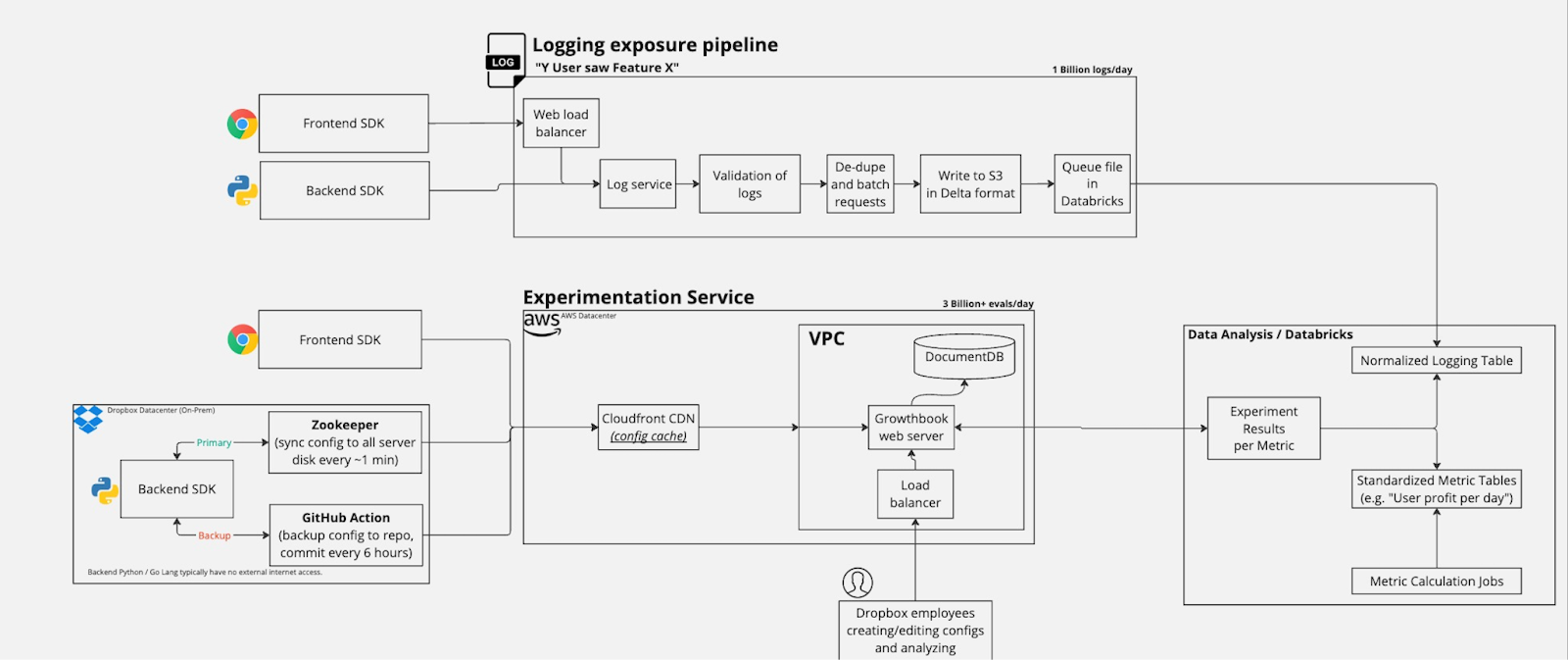
Results
Dropbox saw significant improvements in experimentation speed and efficiency:
- Time Savings: Experiment analysis that could take days is now completed in minutes. This faster feedback loop empowers teams, especially front-end developers, to iterate on experiments without backend changes.
- Faster Experimentation: Front-end developers can now run experiments without backend modifications, cutting setup time from days to hours.
- Scalability and Control: Self-hosting allows Dropbox to efficiently manage 3 billion+ daily evaluations and 1 billion+ logs, with full control over data and compliance.
- Reduced Complexity: The team currently manages both GrowthBook and the legacy system. However, earlier this year, Dropbox replaced a third-party vendor with GrowthBook, significantly reducing the time required to manage that infrastructure.
- Better User Experience: Front-end developers can toggle experiments on and off without reloading pages, speeding up the process.
"With GrowthBook, you can toggle experiments on and off without reloading the page. It's a lot faster for front-end developers,"
— Alex Kalish, Engineering Manager at Dropbox
Future Plans
Currently, about 50% of new experiments each month are being built and run in GrowthBook, compared to Stormcrow. Dropbox’s long-term goal is to fully transition off Stormcrow and move all new experiments to GrowthBook. This migration will continue as existing experiments in Stormcrow naturally expire. Additionally, Dropbox plans to integrate tools like Atlan for enhanced metric management and is collaborating with GrowthBook to develop new features, including improved presentation capabilities for executive dashboards.
Conclusion
Dropbox has successfully migrated off one third-party tool and is now focused on transitioning from Stormcrow, which supports the majority of its experimentation infrastructure. While the migration is ongoing, early wins—such as the replacement of another 3rd party tool and the seamless integration of GrowthBook—demonstrate the value of this effort. Dropbox is on track to fully consolidate its experimentation platforms, with plans to move all new experiments to GrowthBook, further streamlining operations and improving efficiency.